|
Folk Dance Federation of California, South, Inc.
|
|
CLICK AN IMAGE TO ENLARGE
THE BALALAIKA
It's cut out of wood,
It cries in your hands.
18th century Russian riddle
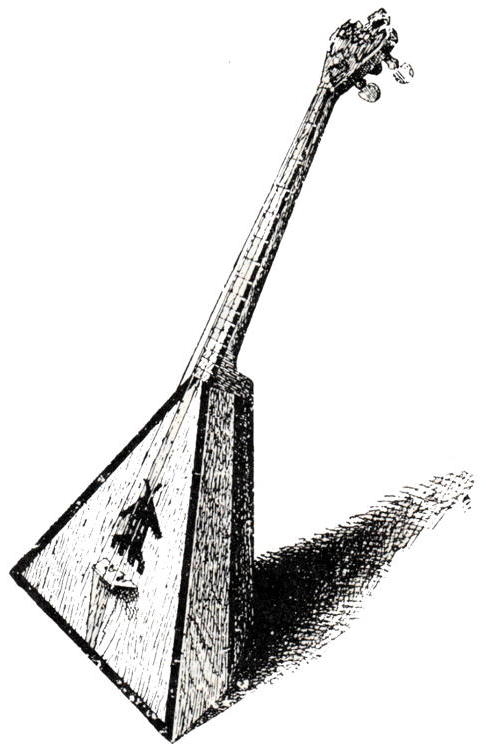
The modern balalaika is the offspring of a mixed marriage of a country gentleman wooed by a peasant girl. The essence of this simple, three-stringed instrument belongs wholly to the folk: to the traveling bards who acconpanied their epic songs on it, to the village musician who strummed out a rhythmic dance tune, to the peasant craftsman who cut it from the trees that surrounded his izba (wooden log house or countryside cottage). But today's balalaika bears only an outward resemblance to its present prototypes, because of the work of a 19th-century aristocrat.
The balalaika is not ancient. It was first documented in 1715 by Tsar Peter I. As part of the festivities surrounding a royal wedding, the Tsar ordered a grand procession through the streets of Petrograd. Each tribe or nationality under his domain was to be represented and each group of participants was to carry musical instruments most typical of their region. The composition of this grand pan-Russian street band was recorded by Peter I himself. Among the drums, shepherds' horns, flutes, fiddles, and zithers, were four balalaikas.
Other chronicles confirm that, indeed, the balalaika appeared among the Russians at the beginning of the 18th century, just as the popularity of the domra (a tanbor- or long-necked lute-like instrument), was declining. This coincidence sone historians take as proof that the balalaika was descended from the domra. Whether this is in fact true, balalaikas appear to be truncated domras, in overall aspect like a coal shovel. They have very long necks with with gut frets, a curved body made from a gourd or gouged from a solid piece of wood, and a soundboard of pine, pierced with a geometrical pattern. These early balalaikas are quite plain and free of decoration, save for a horse or bear carved into the peghead. All of the surviving examples of these early instruments are designed for two strings.
During the latter half of the 18th century and the first part of the 19th, the balalaika spread throughout Russia and became the most popular of Russian folk instruments. One observer wrote in 1769 that there was hardly a peasant home where the instrument was not played. Some ambitious musicians added a third string, increasing the instrument's range and technical potential. Carving and painting were applied in heavier doses to the peg head, back, and soundboard. Craftsmen abandoned the solid "dugout" back and soundboard and began to form this strips or ribs of wood into a triangular box. However, even with this innovation, construction remained simple. Home manufacture of the instrument far exceeded commercial production, and this factor undoubtedly contributed to its popularity.
Despite refinements, the balalaika won few admirers among the leisure class. Most aristocratic authors shunned the instrument and described it as "twangy," "strident," and "anti-artistic."
To a certain extent these prejudices were shared by the father of the modern balalaika, Vasili Andreev. His dissatisfaction with the instrument's limitations, coupled with a great affection for its intrinsic qualities, led him to reconstruct the instrument, develop an orchestra of balalaikas, expand its repertoire, and found a new style of virtuoso players.
Peter Rothe, Odessa Balalaikas
ANDREEV'S LEGACY
Today in the Soviet Union, the balalaika exists comfortably in the world of symphonic art music as well as in the realm of Russian folk music. Such a situation is by no means peculiar to the balalaika. In numerous cultures today, folk instruments have been assimilated Into art music traditions yet maintain a continuing involvement in folk traditions. (In the U.S. the violin is probably the prime example of such a dual existence.) What is unusual in terms of the balalaika is its rapid adaptation from a pure folk instrument to one that plays such a large role in both Russian art and folk music today. Literally, the expansion of the balalaika's musical domain took place overnight. Ihis is due largely to the efforts of one man, Vasili Andreev, who, as we shall see, happened to be in the right place at the right time.
Consider the following: Russia, in the late 19th century, was in a precarious position. While Western Europe was bustling with the activity of the Industrial Revolution, Russia was in many ways still emerging from the "dark ages." The Russian nobility was extremely anxious to be admitted to this rather exclusive clique of "civilized" Western European nations. To achieve adnittance, the nobility was_playing a cultural catch-up game at breakneck speed. Any social affectation that was European was immediately adopted by the Russian ruling class, including styles of dress, standards of etiquette, forms of art, etc. The nobility was determined to transform what they saw as a sow's ear into a silk purse.
At this time in Europe, nationalism was the artistic as well as the political rage. Composers of Western art music were drawing upon folk themes as the basis for much of their music (Wagner in Germany, Rimsky-Korsakov in Russia, Grieg in Norway, etc.). Nationalism threw a real monkey-wrench into the works, for in order to follow the latest European vogue (i.e., become more European), the Russians had to reject some aspects of the European art traditions in favor of more Russian themes. The problem became how to deal with this apparent contradiction: "To become more European by becoming more Russian."
Enter Vasili Andreev (who was that masked man?) with a unique solution. Like the other nationalists of the period, he incorporated a European symphonic treatment of local folk melodies and themes. Unlike any of his contemporaries, however, Andreev discarded the typical Western European orchestra and created his own, based upon the balalaika and its close relative, the domra. In order to accomodate the technical demands placed upon his folk orchestra, Andreev added such refinements to the folk balalaika as mechanical tuning pegs, fixed frets, and standardized tuning. By the time he was through, Andreev had created and entire ramily of balalaikas and domras that would form the basis of his orchestra. The families of balalaikas were closely modeled (range, size, etc.) after the Western European violin family.
The balalaika orchestra was Andreev's legacy. It must have been a good idea, because today his basic complement of Russian instruments is utilized not only in the large symphonic orchestras of the Soviet Union, but also in smaller folk-oriented immigrant ensembles such as the Odessa Balalaikas.
David Lieberman, Odessa Balalaikas
Printed in Folk Dance Scene, September 1977