|
Folk Dance Federation of California, South, Inc.
|

|
CLICK AN IMAGE TO ENLARGE
During the 1800s, on southern plantations and in northern big-city dance rooms ("jooks"), skilled and imaginative Black dancers developed a variety of dance forms derived from African dance characteristics (total body movement; orientation to the earth; improvisation; importance of community; polyrhythms; percussion; pantomime; and something in-hand competition). We look at a few.
PIGEON WING
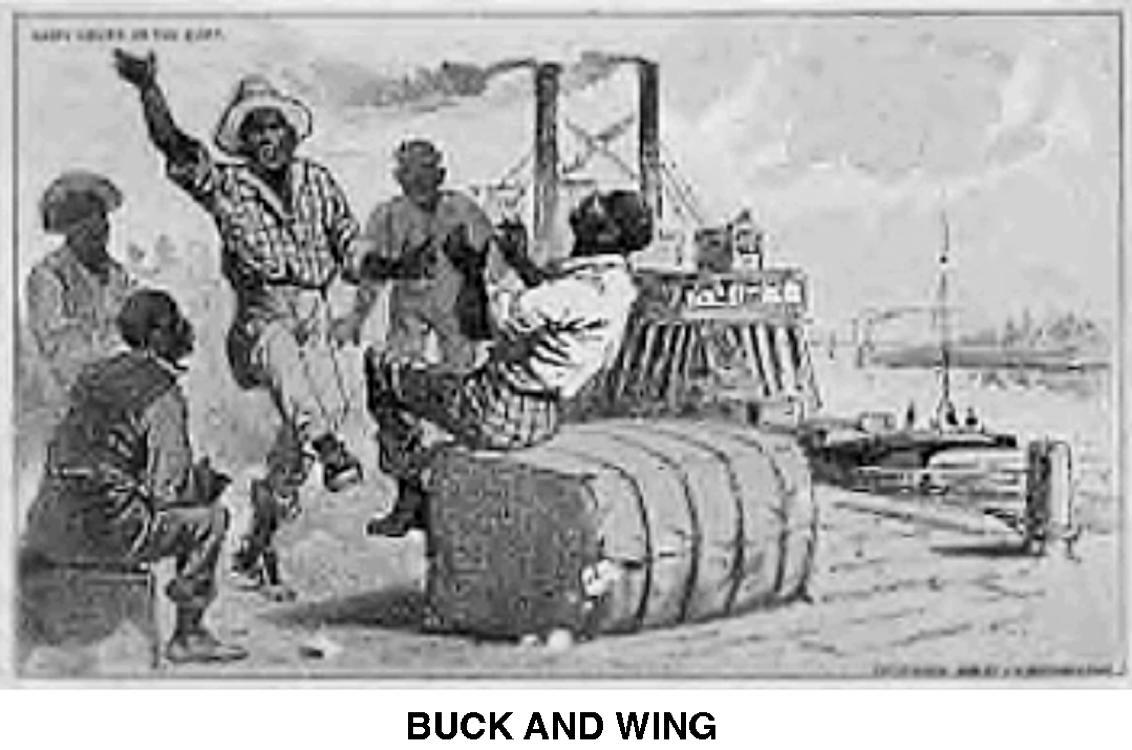 One frequently performed dance, and exercise in pantomime, was named Pigeon Wing – giving you an idea of what to expect. To the accompaniment of whatever homemade instruments were available – banjo, tambourine, pots, washboard, spoons – the dancers, usually men, mimicked a courting pigeon. The neck was held stiff, arms bent colse to one's sides like wings, were flapped. The "pigeon" scraped his feet as he strutted around the floor. Not a dance you would have learned from Yves Moreau – but it sounds like fun.
BUZZARD LOPE
An even more dramatic pantomime had the evocative name Buzzard Lope. Picture a wooden platform, in the middle of which lies a performer representing carrion. As one participant provides a rhythm through patting, another gives instruction to the "buzzard" who, with body bent, arms thrown back, awkwardly approaches the victim, advancing and retreating. "March around" the dancer might be advised. Or "Get more meat." After the buzzards task is done, the caller might conclude the exercise by announcing "All right belly full – goin' to tell the rest."
A Christian version had a white handkerchief in the center of the floor, representing a dead slave who had been denied burial. As the dancer moved around the descedent, the caller would provide words of consolation. At the conclusion, the handkerchief would be carried away by the "buzzard" as the caller assured the participants and onlookers of the slave's salvation.
PANTOMIME DANCES
Black dancers developed many creature-focused dances whose names gave a hint of what one could expect to see: Fish Tail, Turkey Trot, Snake Hip, and Camel Walk. Other pantomime dances portrayed working in the fields and, at harvest time, bringing in the crops.
Some of the Black pantomime dances depicted the physically demanding work required of slaves. Some, like the Cristian version of the Buzzard Lope, gave expression to the harsh treatment many slaves experienced on the plantations. but other dances, the Jigs, the Shouts, and the Cakewalks could convey a feeling of the dancers being carefree and happy with their lives.
Langston Hughes provides the corrective:
Because my mouth
Is wide with laughter
You do not hear
My inner cry?
Because my feet
Are gay with dancing,
You do not know
I die?
From The Dream Keeper and Other Poems
By Langston Hughes, published by Alfred A. Knopf, Inc., 1932
JIG
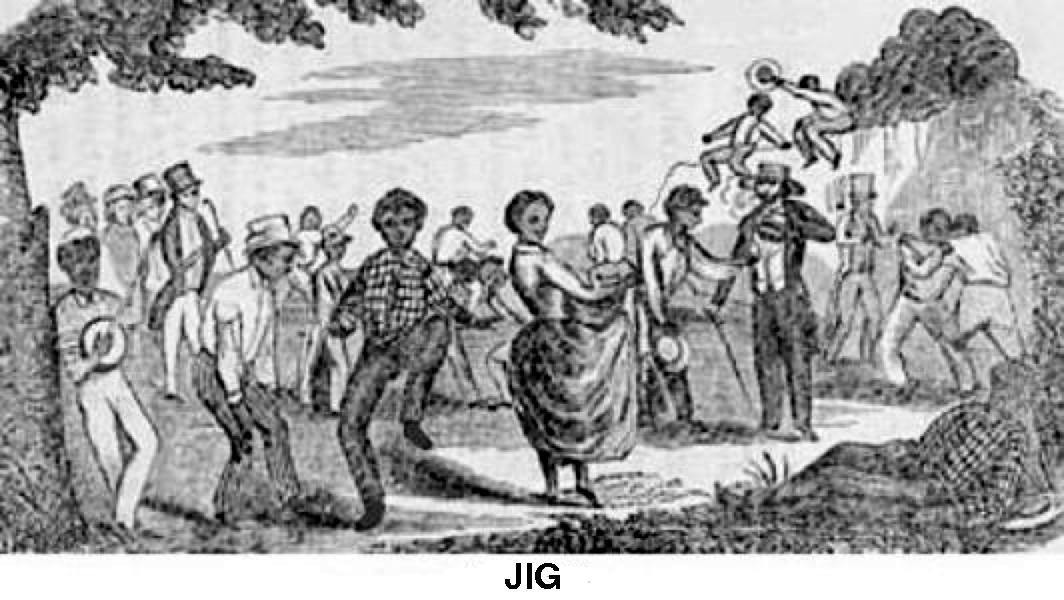 The Jig, created in England and adopted by Ireland and Scotland, is traditionally a dance of flailing feet. The Jig, when used as a generic name for many variations of Black dance, is a dance of flailing feet accompanied by frenetic upper-body movement. Typically, a man selected a lady from a circle of participating dancers and led her, waving her handkerchief overhead, to the center of the floor where she shuffled from one side of the fiddler to the other. Her partner danced behind her with syncopated steps. The circle of dancers would clap and sing and offer encouragement as the man began his "breakout" performance, which might involve heel and toe hits, hopping from one foot to another, springing on both feet, and dancing with a glass of water on his head. One spectator described the dancer he saw as throwing "his whole soul and body into the dance..." his feet "stamping, slamming, and banging the floor." (Emery, p111)
After ten or so exhausting minutes, a replacement might step in.
The Jig, created in England and adopted by Ireland and Scotland, is traditionally a dance of flailing feet. The Jig, when used as a generic name for many variations of Black dance, is a dance of flailing feet accompanied by frenetic upper-body movement. Typically, a man selected a lady from a circle of participating dancers and led her, waving her handkerchief overhead, to the center of the floor where she shuffled from one side of the fiddler to the other. Her partner danced behind her with syncopated steps. The circle of dancers would clap and sing and offer encouragement as the man began his "breakout" performance, which might involve heel and toe hits, hopping from one foot to another, springing on both feet, and dancing with a glass of water on his head. One spectator described the dancer he saw as throwing "his whole soul and body into the dance..." his feet "stamping, slamming, and banging the floor." (Emery, p111)
After ten or so exhausting minutes, a replacement might step in.
Plantation owners sometimes "invited" their slaves to perform the Jig for them at the Big House and occasionally arranged jigging contests between plantations, where owners placed bets on the ability of their competitors. During slave auctions the overseer might demand that a slave dance a Jig to demonstrate his physical fitness to prospective buyers.
JUBA
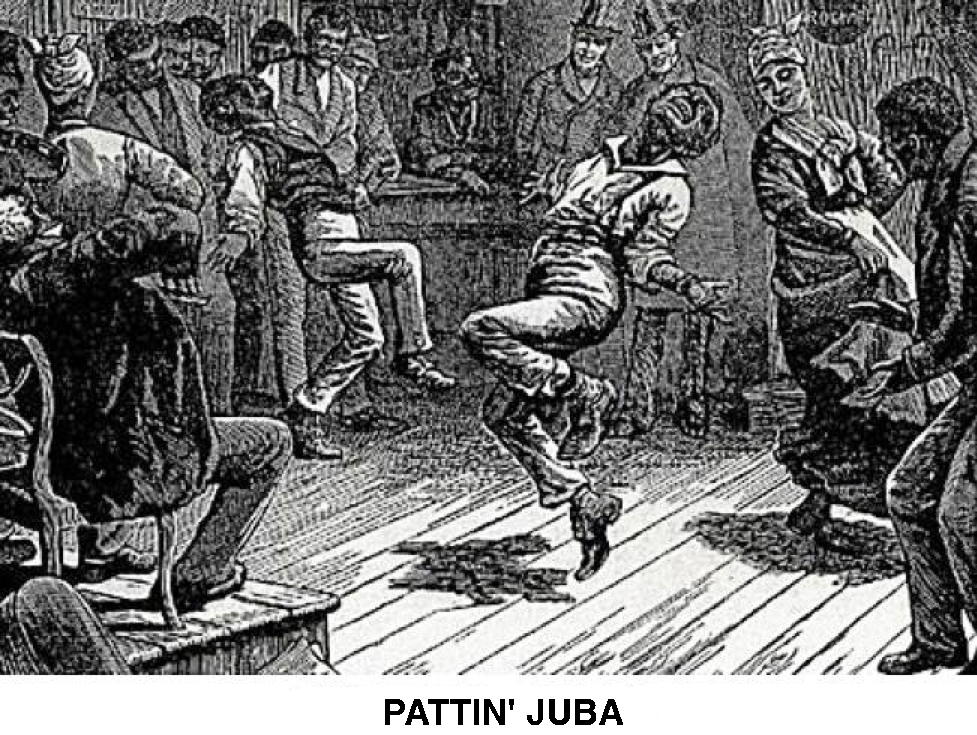 Juba, sometimes called Pattin' Juba, was a special form of the Jig developed when drums were forbidden by plantation owners. In addition to the usual Jig pyrotechnics, the spotlighted dancer rhythmically clapped his hands, slapped his arms, chest, and thighs. Juba competitions were frequent.
CAKEWALK
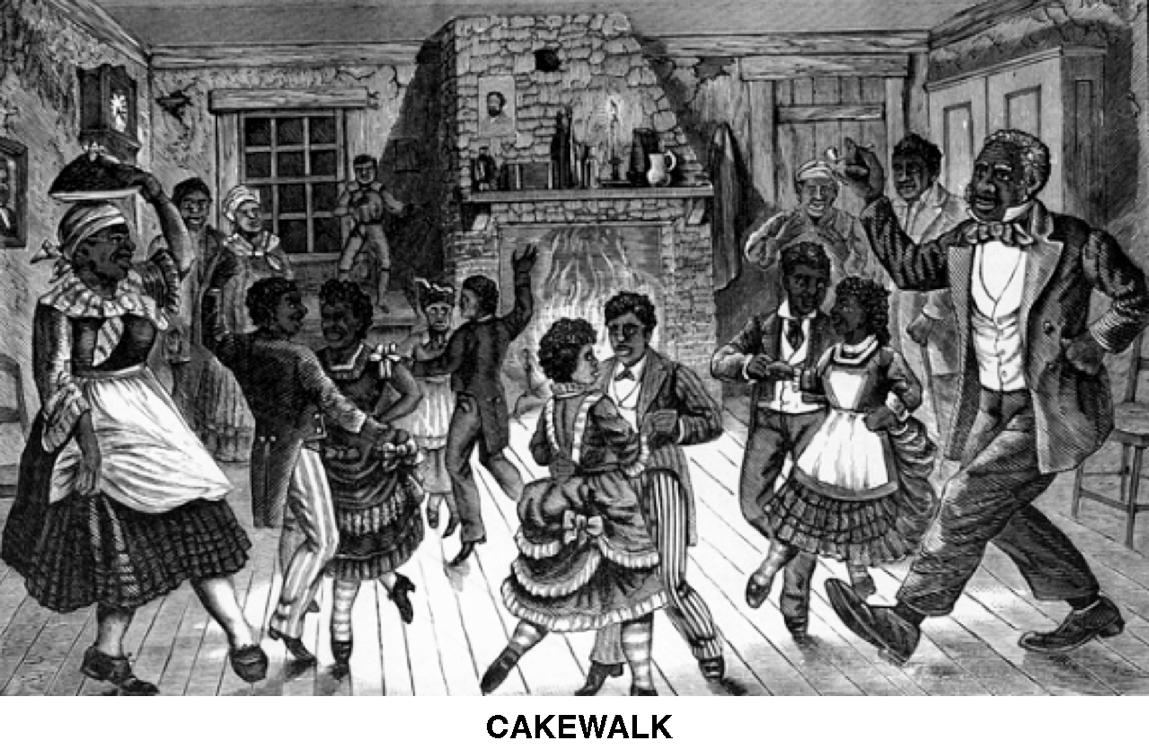 Black dancers, from the mid-1800s on, showed their dancing skills not only in vigorous WOW! dances, but also in displays of elegance and grace. The Cakewalk, initially called Walk the Chalk Line, exemplified these elements of dance.
To prepare for a performance a yard space was swept clean, benches placed around, and boards lined up to make a pathway. The slaves, dressed in their very best clothes, gathered at evening with candles and burning pinecones to light the area. Often members of the plantation ownership came to observe. The competing couples, in turn, strutted down the wooden path to the tune of a banjo, head held high, torso leaning slightly back, feet kicking forward. At some performances the excitement was enhanced by having the competitors balance a glass of water on their heads. The couple judged to have most gracefully negotiated the path – and, perhaps, spilled the least amount of water – was awarded a prize cake, one bake by the slaves themselves or, occasionally, by the mistress of the plantation.
Over time, slaves became expose to the balls and cotillions held by the white folks in their plantations. Then they might use the Cakewalk to parody the waltzes and minuets they had seen performed.
By the late 1800s the Cakewalk had become an integral part of minstrel and vaudeville shows.
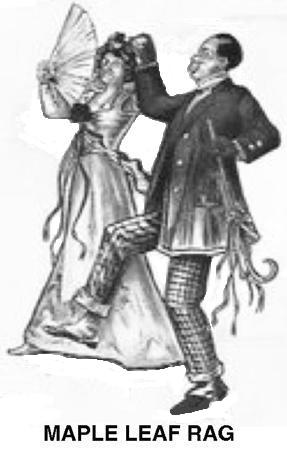 In the antebellum South, some musically talented slaves began to toy with European melodies, adding rhythmical schemes to them, a process they called "ragging." toward the end of the 1800s, Scott Joplin, a Black composer, championed their cause with the result that Ragtime music, with its danceable rhythms, became a fad. Folk dancers can appreciate their accomplishment, providing us with the pleasures of Maple Leaf Rag, Salty Dog Rag, and Twelfth Street Rag.
After emancipation, Black dance halls sprang up in some Southern cities, mirroring those that had been in existence in the North. Familiar Black dances became augmented by new dance creations.
In vaudeville, on stage, and in night clubs like the famous Savoy of Harlem ("the home of happy feet"), where white customers were entertained by Black performers, and eventually on television, Black dancers augmented and transformed the American dance vocabulary by creating and/or shaping dances that took over America's ballrooms with Shimmy, Black Bottom, Big Apple, Lindy Hop (the precursor of Jitterbug), Charleston (whose precise origin is in dispute), and the Twist (among others).
The incorporation of some of these dances into American dance was met with controversy. A few churches saw temptation lurking and opposed all dance. Some white people were uncomfortable with the eroticism of certain dances. A number of Black folk, eager to assimilate into white society, wished to sever dance from its "uncivilized" African roots. But the tidal wave was unstoppable.
Eventually, under the influence of Black youth in New York, dance even escaped the ballrooms and stages and took over the streets in the form of Break Dancing.
Black dance has become an interwoven, indispensable part of the American dance scene.
BIBLIOGRAPHY
Lynne Fauley Emery, Black Dance, from 1619 to Today, Second revised edition, Princeton Book Company, Publishers, 1988.
Barbara S. Glass, African American Dance, An Illustrated History, McFarland & Company, Inc., Publishers, 2007.
James Haskins, Black Dance in America, A History Through its People, Thomas Y. Crowell, 1990.
Katrina Dyonne Thompson, Ring Shout and Wheel About, University of Illinois Press, 2014.
Printed in Folk Dance Scene, February 2021