|
Folk Dance Federation of California, South, Inc.
|
|
CLICK AN IMAGE TO ENLARGE
West African dancing is being brought to the attention of American audiences with increasing frequency in recent years through performances of the touring dance companies launched by several justifiably proud West African nations. The Ghanaian company, under the distinguished direction of J.H. Kwabema Nketia, sometimes lecture in music at UCLA, is possibly the finest if not the most commercial. It's repertoire consists principally of Ashanti and Ewe music and dance, and reveals the contrasting cultures of the two most influential ethnic groups in the country.
The AMAN Folk Ensenble performed a representative dance from each of these groups: "Sohu Adahu," an Ewe dance, is an example of the cult (Yeve) funerary dance, as well as of the energetic Ewe style. It should be noted that the funeral party dancing constitutes a very large part of all West African indigenous dancing. "Kete Atane" is not only one of the great number of artistocratic Ashanti dances, and is performed by the ladies of the court, often especially for the Queen Mother. Many West African dances are strictly regulated by protocol and numerous complicated social and religious restrictions.
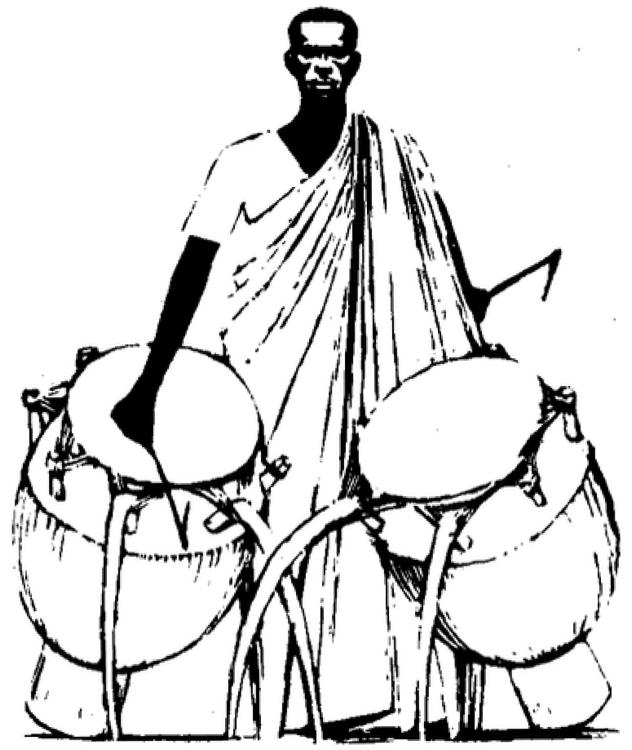 The Guinean and Sierra Leone national companies both include dances from Soolimana, of which Major Alexander Gordon Laing wrote in the first quarter of the last century. He astutely observed that the graceful and vigorous dancers performed with "...the body and knees being bent into the shape of a Z...," a recurring posture in most West African dancing.
Although the Yoruba and Ibo of Nigeria possess very rich dance and music traditions, American audiences have not yet had the opportunity of enjoying them. The Hausa of Northern Nigeria share a cultural heritage with their Moslem co-religionists in Niger, Upper Volta, Mali, Guinea, and Sénégal. Music and dance of these areas is sufficiently similar within the Moslem population to be grouped in a generalized way.
This presents an interesting point for those who haven't recently seen the outstanding Mali Ensemble and look forward to the Sénégalese: the existence of two separate music and dance styles in the country south of the Sahara. The indigenous style is best exemplified by people with a unique and unbroken tradition, like the Ashanti. The imported style is the result of a millennium of Islamic influence in the Sudanic empires and the Emirates.
The attitudes toward music and dance differ considerably within these two cultural structures; the Moslem peoples fostering a cast of professional entertainers, and the indigenous cultures integrating music and dance into the whole complex fabric of their social patterns.
This letter attitude has encouraged the proliferation of social dancing in the larger coastal cities such as Acura and Lagos. This dancing, known variously as "High-Life, Pandugo, Palungo, etc., developed from such village debutante dances as the Ashanti Sikyi. Completely secular and international in flavor, High-Life has become the sophisticated social common denominator for a modern West Africa where Syprian Ekwénsi (in Jagua Nana) can write of a nightclub in Lagos where "The band was playing a new hit tune from Ghana..."
Printed in Folk Dance Scene, March 1973