|
Folk Dance Federation of California, South, Inc.
|
|
CLICK AN IMAGE TO ENLARGE
 Picture this. There is a population of Spanish-Americans (Californios) living in the chaparral regions of the North American west. They are wealthy, successful cattle and horse ranchers, with a strong cultural background that applauds gentility, dignity, and grace. Underlying is a fiery, sensuous, expressive personality. Amusements are approached with gusto, daring, and sensuousness. They are a generous, warm people, inviting everyone to their fiestas, parties, and other social gatherings, almost all of which included dancing. The native Spanish Californians danced continually – there was a fandango or baile every night, except in times of death or sorrow. The term "fandango," though originally denoting a particular kind of dance, was used for an evening's dance entertainment, in which many different dances are done. El jarabe, a dance with rapid, precise steps, could be seen, along side of the waltz, a regular favorite. Because of the dichotomy of classes in Spanish society, the term fandango was re-interpreted during the Gold Rush. Any major event on a Spanish ranchero that featured informal daning or a general ball was called a fandango. Because of the mass emigration of all manner of people after 1840, dance events came to reflect and emerging social stratification – bailes (balls) came to denote dance events by invitation only while fandangos became "lower class" (including most miners) entertainment. The term fandango was then indiscriminately attached to any dancing, with or without Spanish flavor, that the miners could concoct in their camps.
For the original fandangos, a great three-sided arbor (ramada) was constructed in front of the house chosen for the dance. It sheltered a large area of dirt packed down for the occasion. The fourth side was left open to allow men on horseback to attend. The women were seated on benches placed at the sides of the arbor. The music, consisting of a violin, a guitar, and a few singers, was placed at the far end of the arbor. The master of ceremonies, the tecolero, organized the dance. It was his responsibility to lead each lady, in turn, to the center of the floor to perform her solo dance when such music was played. If, on the other hand, the music being played was for a partner dance, men would alight from their horses, introduce themselves, and request the dance with his selected partner. When the dance ended, he would lead the lady back to her seat and then remount his horse.
Certain of the dances, the sones, were so called because they were done to specific songs, and the dance followed the movements indicated by the song. La Jota is perhaps the best known sone of this type of dance. The couples, with the woman on the man's right, formed two lines that faced each other. When the music began, the singers started their verses. Immediately, each two pairs began to do figures consisting of moving arms and hands capriciously, taking care that the figure last as long as the verse. Immediately followed by another chorus, and so on. The dance continued until the singers ran out of verses!
Another well-known dance, La Bamba, was done only by the most skillful of women as it required that they carry a glass of water on their heads during the dance. One of the spectators would put a handkerchief on the ground in front of the dancer, with its points tied to make it like a wheel. The dancer would then take up the handkerchief with her feet, conceal it, and carry on with her dance. Sometimes two or three handkerchiefs were put before her in this way, and she would hide them all. Still dancing, she would return and put the handkerchiefs back on the floor, never having spilled a drop of the water in the glass on her head. When she finished, the tecolero would take the glass from her and she would return to her seat. Spectators would throw money at her feet in appreciation; others put their hats on her head, or placed their kerchiefs on her shoulders. The owners of these objects recovered them later in exchange for some gift or reward in money to the dancer.
...I seen the elephant
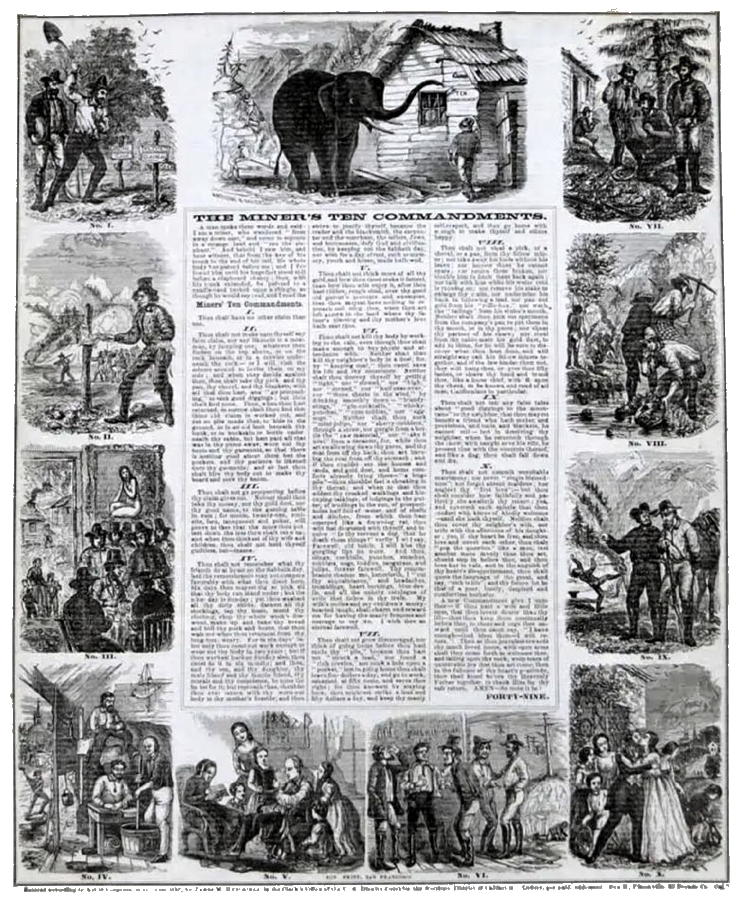 Now picture hordes of east-coast emigrants coming over the land like locusts, seeking their fortune in the newly discovered mines of the area. This is a mixed group composed of people who had come to America from various European countries (France, Germany, Scandinavia, the British Isles, etc.), each carrying elements of his own original culture. Each was drawn to the west by the promise of wealth, each sought his dream. To the miner, the following story symbolized the experience of reaching California: getting outfitted for the mines, going in, coming out, and – if missing death and passing by the lures of San Francisco – coming home.
A farmer heard one day that the circus would be coming to a neighborhood city, and with the circus would be a real elephant. All his life he had heard of this fabulous beast, and the desire to see one grew in him and troubled him mightily. He set out for town wih his wagon loaded with goods for the market. As he neared the town, he came upon the circus managerie traveling towards him.
His horses reared in fright, his wagon turned over into the ditch, his eggs were smashed, and he himself was battered and bruised. But he rose from the ruins triumphant.
"A fig for the damage," he cried, "for I have seen the elephant!"
One might "see the elephant" by having too much gear, getting annoyed by the weather, getting fever, or having hard luck at the digs. Or, experiencing such "little conveniences" as irregular meals, no beds, no wells, battling the mosquitoes, bedbugs, and cockroaches. To get the most of these experiences was to "see the elephant" and graduate from greenhorn status.
To survive, the miners-to-be had to change. The most immediate and striking change that came upon them was an increase of activity and, proportionately, of reckless and daring spirit. The experience was exhilarating, with unlimited opportunity to stretch out and break the boundaries of previous social organization. Then, too, there was anxiety – failure and death were constant threats. Depression led the miner to the saloon where he sought comic relief in practical jokes and masquerading. Spirits had to be kept high. The pace of the miners life was fast; the longest period of time ever thought of was a month.
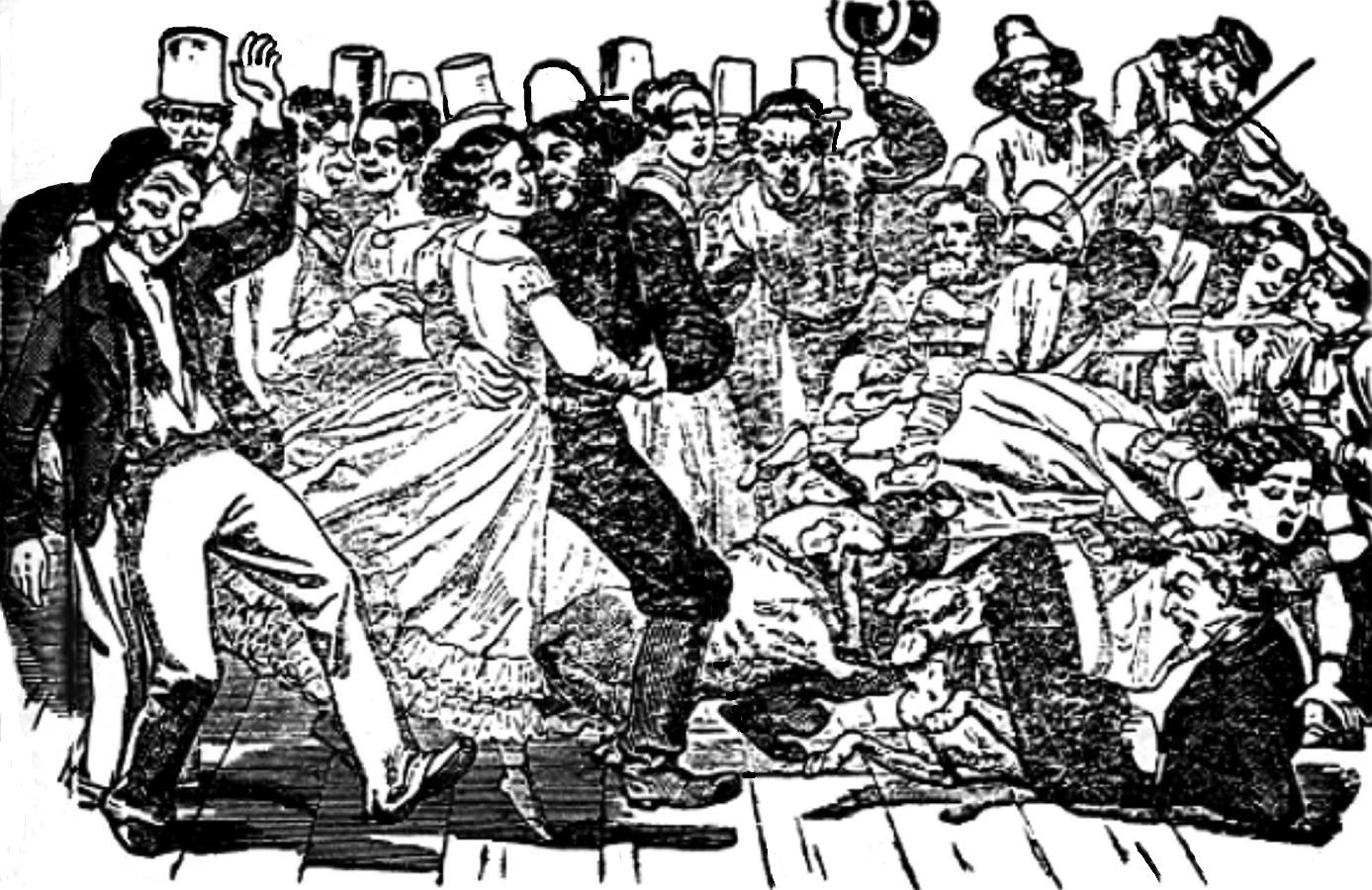 The nearly all-male group separated out into a number of mining camps scattered throughout the region once only populated by the ranchers. Of course, there was interaction between these groups. On Saturday night and Sunday, the miner's day of rest, they sought pleasure fiercely. The miner's hell-raising Sunday was sanctioned by the Spanish tradition of fiesta Sunday. The Spanish Californian was accustomed to pleasure – it was a natural part of his life. Dancing was often with the local señioritas. The miners watched these events, often joining in the fun at the Mexican encampments. They tried the steps and burlesqued their own efforts at the graceful Spanish movements, bringing all this back to camp.
The varied elements within the mining camps worked to create a fluid atmosphere where European, eastern United States, and improvisational patterns were blended and then overlaid on the Spanish Californian's dance genre. Most of the miners brought their native dance traditions with them, adding them to the already flourishing Mexican fandango. These elements, together with gambling, produced the "fandango house," patronized by miners and Spanish alike. The "ball" of Eastern seaboard origin and traditional formality merged with the growing camp life to compete with the "dance hall" of Spanish origin. Add this to the general drunkenness, the dance culture that the men brought with them, and you have the beginnings of the Gold Rush miner's dances.
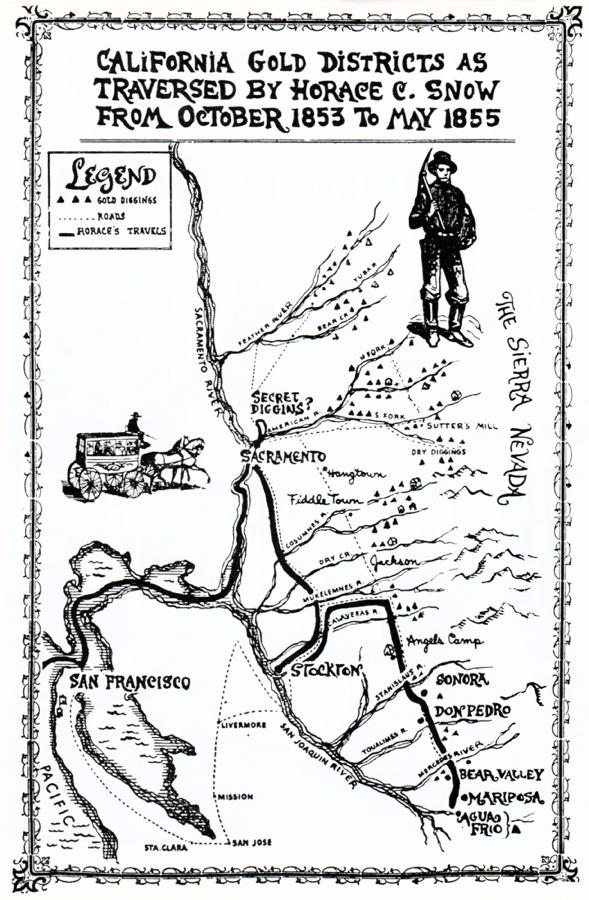 The first camps were crowded, noisy places, filled with a mixed, motley, restless crowd of men. Troupes of Frenchmen, crowds of Chinamen were common. As the towns grew, the status of the miner changed. Independent miners were forced by mining "technology" to rely more and more on group mining efforts and social structures to survive. Similarly, all balls and amusements were open to the whole community. Early dances were spontaneous outbursts. Wherever a fiddler could be found to play, a dance was got up. It was customary in the mines for the fiddler to take the responsibility of keeping the dancers all right. He would go through the dance orally, shouting his directions loudly to the dancers – "Set to your partner," "Ladies' chain," and other dance directions. After all the figures of the dance had been done, he would announce in an even louder voice, "Promenade to the bar and treat your partners." In this social structure, the miner applauded the virtues of manliness and strength. Success in mining and consequent wealth, prowess in hunting, display of wealth in costume, and the bravado of dancing a special step or performing a step in a particularly funny or intricate manner were greatly admired.
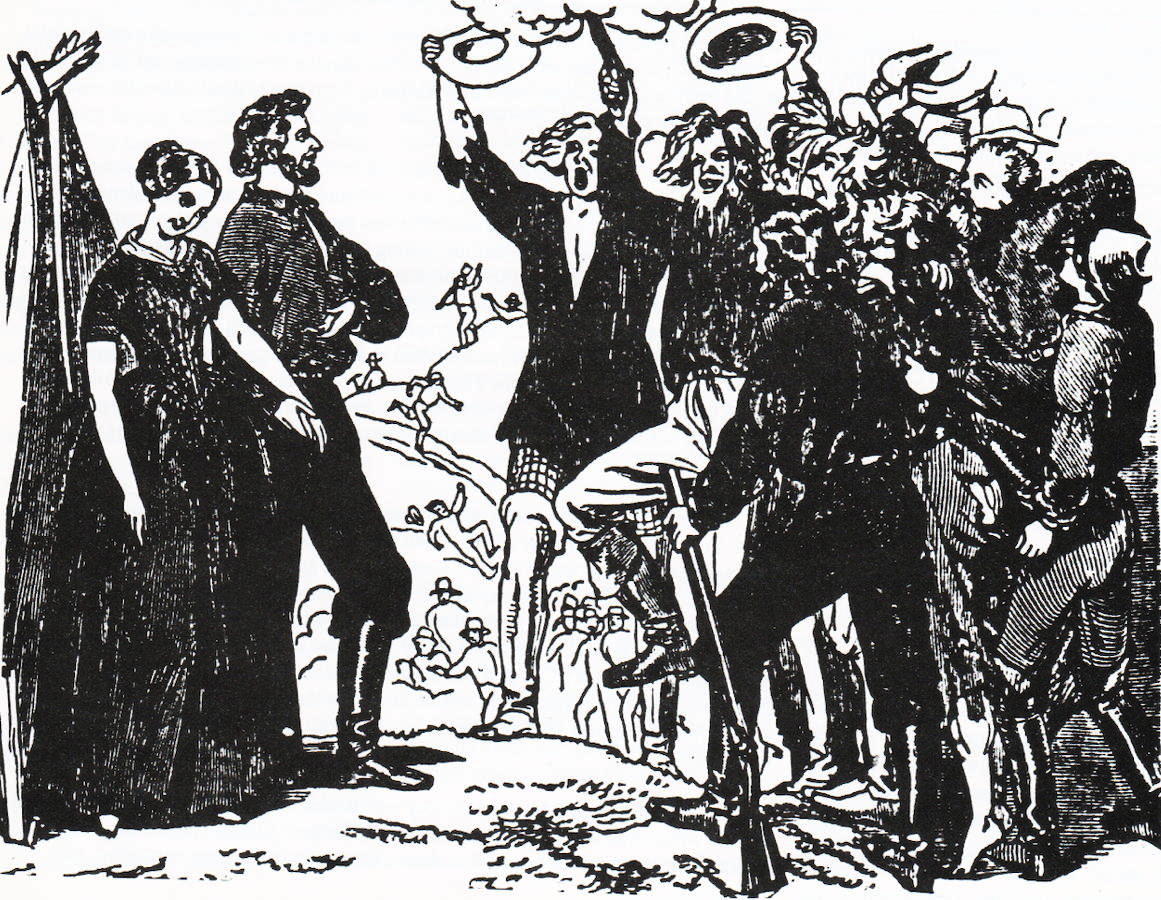
Though there were women in the camps – Spanish Californians, Indians, and "foreigners" (Chinese, French, German, etc.), "ladies" by Eastern standards, were scarce, and those that did come did not stay unmarried for very long. Few women came to California in 1849. The men, homesick in a rough, all-male community, idealized the concept of woman. And when a woman arrived in camp, it was an occasion for wild celebration! In the saloon or gambling hall, where most of the men gathered on weekends, the female image was displayed with a kind of reverence. Any part of a woman's apparel could be an object of ritual. One story told in connection with the subject goes as follows:
In one place in the mineral regions, part of a lady's hat was found. This caused so much excitement that it was immediately decided to have a ball on the spot, in honor of the event. Invitations were immediately sent out, and on the date of the ball, over 300 men appeared, each with a bottle of brandy. In the exact spot where the hat was found, they drove a stick, five-feet high, on top of which was placed the hat. Around it was a miner's cradle, in which was placed a smoked ham, also wrapped in a flannel blanket. At the close of each dance, the leader of the ball rocked the cradle, while another poured a bottle of brandy down the back of the "lady's neck."
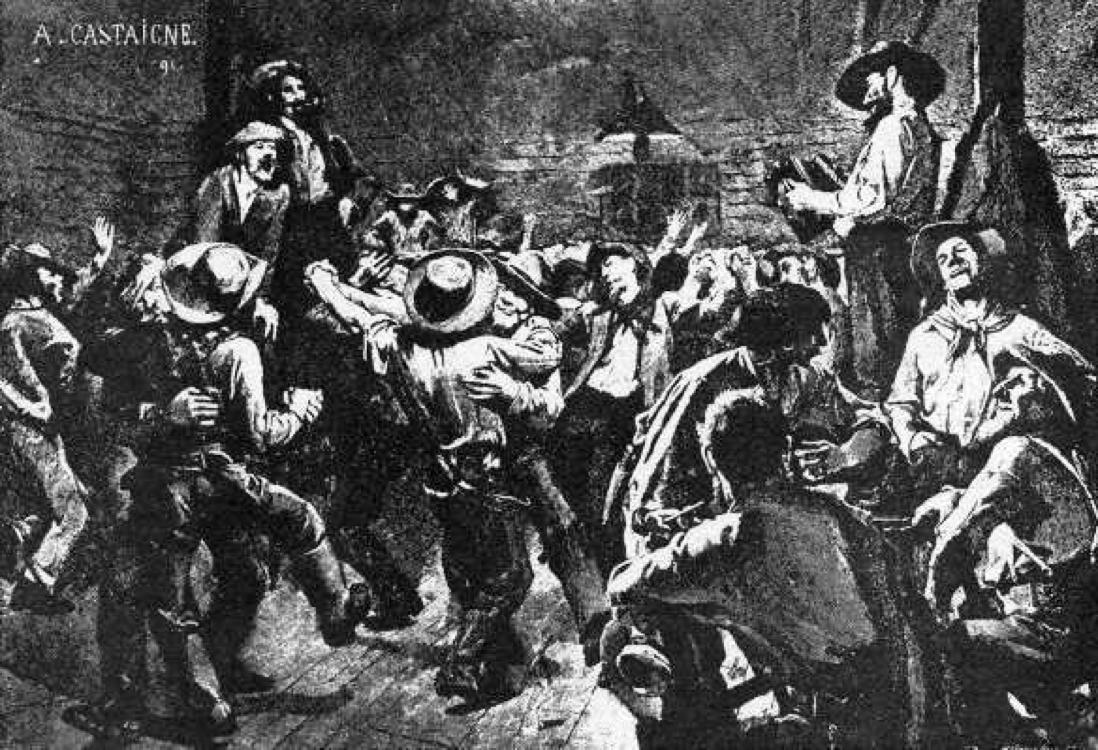 Miners looked forward to almost the only opportunity for properly meeting and courting young women – a dance. For example, there was a Fourth of July celebration at Selby Flats, where there would be ladies to dance with. But men often danced with each other in couples – the female designated by patches, a scarf on the arm, or a piece of female clothing. Occasionally a miner would go so far as to wear the full costume of a woman. It wasn't until 1852 that there were enough women in Placer County to give balls on any kind of regular basis. There were 345 women in total population of over 6,000. (Statistics of the time are similar for all counties in the mining areas.) The balls had so few ladies attending that those present were danced to a state of exhaustion. At the balls, floor managers introduced men and women, seeing that the women were always engaged in dance.
Waltzes and polkas were not so much in fashion as the "Lancers" that seemed generally well known. A pas seul, or solo dance, sometimes varied the entertainment. For example, one might see a performance of the Highland Fling by a miner of Scottish ancestry. The absence of ladies was a difficulty that was easily overcome – men identified by patches placed on a conspicuous part of their anatomy, simply danced the woman's parts. The audience for such dancing was predominately casual or indifferent and passive; dancing was concurrent with other activities – smoking, drinking, gambling, and talking. The "female" partners mimicked that sex. A miner would dance anywhere and for any occasion. His lack of self-consciousness was because, in part, of the quantity of alcohol he drank. Additionally, particularly Yankees whose dance tradition had been under the strictures of Puritanism and Calvinism, were caught up with dancing in California as a mania. Free, on the frontiers of the United States, their fever was fed by the image of gold and the customs of Spanish dancing. Masquerade balls, cotillion parties, and jib dances filled up the list of Sunday diversions.>
After 1850, the ambiance of the dance scene changed. Professionally-run "fandango cellars" and "dance halls" appeared at the mining towns. The procedure in these establishments was for a man to buy a dance with a professional lady. Dance houses were supplied with women to act as partners to visitors. Many of these women were immigrants of German or French origin who were sent out by a contractor to various dance houses, or to country ranches, at a goodly rate. The women received shelter, food, clothing, and a gratuity from the contractor for their services. They danced everything – the polka, the mazourka, and the varsovienne; not to mention straight fours, hoe-downs, shuffles, freeze-outs, and Jersey reels.
 As camps grew and women arrive, the need for stratifying society became paramount. The "Ball," based on formal, traditional ritual, existed beside the dance hall. The need for respectable occasions was sought so fiercely by the miner that he would often invent one. Hence, the "Ball," a regular civilized Fandango on a European scale, that could be attended by the "Ladies." Invitations were sent out and rarely ever refused. The dances were all those fashionable in the old world with, periodically, the Samacueca, a dance of Spanish Californian origin. There also was plenty of singing in French and Spanish, and the supper was an elegant feast.
Music provided was played by a piano, a violoncello, a harp, a violin, and a few guitars. The Spanish guitar and the violin were the basic California instruments. In the beginning, fiddlers roved through the country, following the fortunes of the digs. An Arkansas fiddler or a Black fiddler were common. When dancing became an organized, planned ritual, camps had their own bands.
Until camps were very settled, Mexican bands often provided dance music for balls, because they were more practiced than the newly arrived miners. Flute, harp (or piano), and guitar were the usual combination. Dance orchestras were generally unrehearsed, and it was the fiddler or caller who was responsible for the repertory. In one description of a ball, it was said that the band played three pieces alternately – waltz, contra dance, and quadrille.
Although camps all followed the same form of evolution, some developed sooner than others or died early as gold mines became exhausted. What emerged was a hierarchy of towns and camps, with fierce competition amongst them for acquiring the elements of "civilization." Dancing played an important role in the camps' bid for prominence. The appearance of dancing schools and dancing masters around 1852 highlighted the graduation of the camps to permanent settlements. Unfortunately, the dancing master squelched the spontaneity and individuality of mining camp dance. Now there were positions to be learned and exact steps to be performed. Local variations were discouraged. The dynamic of the dancing school consumed the exuberance of the five years past; men became self-conscious in the new social order. Both men and women in formal attire had an emphasized rigidity of waist and chest in the cut of their clothes. The clothing, in contrast to the Spanish style of dress that was easier, allowing for the posture of dancing resulting from passion of expression, was functional for dancing correctly in the learned patterns.
An early Ball scene is described in J.A. Stone's "California Ball":
|
'Twould make our eastern people cave,
On foot they through the diggings wind,
A dozen babies on the bed,
The manager begins to curse, |
Old women in their Bloomer rigs
A yearling miss fills out the set,
A married woman – gentle dove –
A drunken loafer at the dance, |
Bibliography
Coronel, Don Antonio Francisco. "Things Past: Remembrances of sports, dances, diversions and other domestic and social customs of old California." Touring Topics, September 1929.
Schneider, Gretchen Adel. "Pigeon Wings and Polkas: The dance of the California Miners." In: S.J. Cohen, ed., Dance Perspectives 39; Winter 1969.
Printed in Folk Dance Scene, May/June 1997