|
Folk Dance Federation of California, South, Inc.
|
|
CLICK AN IMAGE TO ENLARGE
MAZURKA:
"A Polish folk dance in 3/4 time;
a ballroom dance in Eastern and Central Europe based on the folk dance;
a character dance in ballet."
(The Dance Encyclopedia, Simon and Schuster, NY)
Over 100 years ago, Friedrich Zorn, German dance teacher and author, characterize the Mazurka as "the most beautiful social dance of our time, and the author knows by his experience of more than 50 years that everyone who has properly acquired the dance prefers it to all others." (Grammar of the Art of Dancing on Perine) Today, almost 300 years after the Mazurka began its international career, the interest in this dance is still alive.
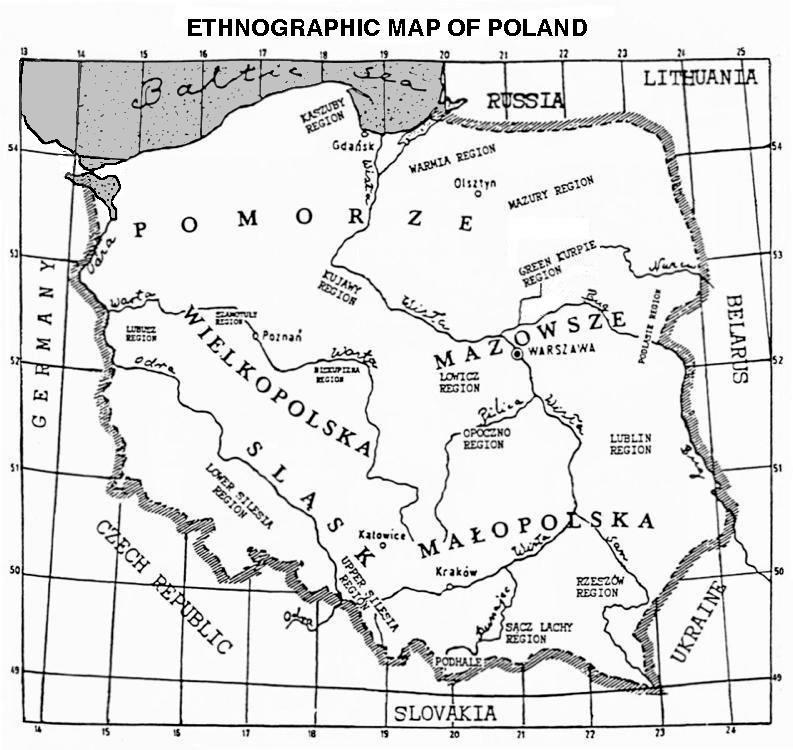
The origin of Mazur is in the villages of Central Poland, in the Mazowsze (Masovia) region. In its prototype, danced by the ethnic group called Mazury some 400 years ago, it was in a deluding fashion and dancing with them for longer or shorter periods.
From the peasants, the dance was taken over by the Gentry (szlachta). When Warsaw became the capital of Poland in 1596, Mazur spread throughout the country and found its way to the courts of the nobility, reflecting their style of life. The dance instructors and teachers altered it artistically arranging the various steps and figures in a certain order. Mazur had started its international career! It began penetrating to neighboring countries, and was introduced into the courts of Germany and Russia.
In the second half of the 18th century, Poland was partitioned by Russia, Prussia, and Austria. Oppression of the participating powers, particularly Russian and German, caused unusual resistance among the Polish people. This was especially manifested in their attachment to traditional folk culture: customs, rites, music, dance, and costume. By wearing the Polish costume, people still belonged to their country, even if it didn't officially exist on the political map of Europe. Strong reprisals provoked even stronger reactions. The Poles had to struggle in order to preserve their cultural identity, as well as to regain unity and political independence.
This desire was dramatically demonstrated by several uprisings. When the Kosciusko Insurrection collapsed in 1794, thousands of Poles immigrated. The time of the Mazur's most spectacular career was about to come to an end. This was the time of Bonapart's brilliant campaigns in Italy, and his many victories offered the opportunity for establishing Polish military units. The Poles sensed a chance for their divided country. In 1797, General Henryk Dabrowski became the Commander-in-Chief of the Polish legionnaires who carried the Mazur with them to every corner of Europe. The Mazur seemed to give them a certain inspiration not found in any other dance, entering their souls, and driving away all fatigue. Foreigners recognized it almost instantly, and while admiring the Polish original style, simultaneously created their own versions of the dance, calling it the Mazurka.
Because Mazur in Polish means the male inhabitant of the Mazury sub-region, the Mazuka means the female of the same region. It is difficult to explain why people outside of Poland call this dance Mazurka, la mazurka, la masoure, die Mazure, or other variations along those lines. Some the charming mutants of their prototype, some just insipid imitations having very little in common with the Mazur. In 1847, Celarius, the French teacher, explained, "I offer this new quadrille to the public in some sort of a specimen and foretaste of the mazurka, a kind of compromise between the French and Polish dance." In spite of the peaceful negotiations, the displaced legionnaires longed for an armed return "from Italy to Poland." This idea found its expression in a song composed by Jozef Wybicki (Dabrowski's friend) called "Jeszcze Polska nie ziginęła" (Poland is not yet lost). This Mazur melody with its brisk rhythm strengthened the hearts of the Polish soldiers, and in time became Poland's national anthem.
When the legionnaires finally entered Poland in 1806, they were welcomed with love and enthusiasm. During this time, the next form of the Mazer was being shaped. After the "peasant, regional: and then the "national, nobility" styles, the ballroom form became prevalent.
It's popularity in Polish towns and cities came from the sojourned of the "Ulania," the soldiers of the "Duchy of Warsaw and the Congress Kingdom." "Jeszcze jeden mazur dzisiaj ćhoc poranek świta" ("Let's dance the mazur once again even if the dawn comes up," sang the Poles across the country while dancing the last of many mazurs for the night.
Mazur became fashionable among the upper classes in Paris. In the early 19th century it spread to Italy, England, and from there to the United States.
Says Cellarius, "Of all the dances that of late years have been introduced into the Parisian ballroom, there is none that has a character more marked with vigor and originality than the mazurka, the Polish origin..."
With the tendency during the Romantic Period towards glorifying aspects of rural life, some dances were adapted for the stage. The Mazur was introduced to the stage by Polish and foreign composers of operas and ballets. It would be impossible to omit the Mazurs from the Polish national operas of Stanislaw Miniuszko (1819-a872), "Straszny Dwór" (The Haunted Castle) and "Halka." The Austrian dancer, Fanny Elssler, brought character dance to the ballet – she first presented Krakowiak ("La Cracovienne," another Polish national dance) and later Mazur ("La Mazurka") on the stage, conquering the New York audience in 1840 with these two dances.
Also during this. Frederick Chopin (Szopen), the Polish composer and pianist, recognize the richness of Polish folklore, composing 58 "mazureks" during his short lifetime. Another Polish composer, K. Szymanowski (1882-1937),gained international recognition for his mazureks at the beginning of the 20th century.
After the first period of Romanticism, with its idea of glorifying aspects of real life and seeing in them the idea of national revival, the sentimental approach changed into a serious interest in folk culture (19th century). During this time, thanks to the reforms of the 19th century, peasant culture blossomed. These reforms, giving far more freedom to the peasantry, allowed individual economic growth, which in turn brought several positive effects. A wealthy village society was established and colorful costumes appeared all over the country. For the first time, collectors of folklore began to collect folk dance as as well as other aspects of culture. A series of publications appeared containing documentation of traditional customs, family and community rites, dance, music, and costume.
In 1860, Karol Czerniawski, in his work "about the national dances" describes Mazur as "compounded of impulse and majesty, free from all restraint; it has at the same time something of pride and even of the martial... "
In 1879, Karol Mastenhauser, the Polish dance teacher, published his work, "Mazur, It's Principles and 125 Figures." In his last addition, published in 1894, he says, "One of the most difficult, but also one of the most beautiful dances of our time, featuring life and skills of our youth, is Mazur, which vitalizes almost all of our drawing rooms; it's music, even for those who don't know how to dance, stimulates and encourages to the common dance."
After 123 years, the events of World War I returned independence to the Polish people. Sovereign Poles expressed their joy through the beloved Mazur, "Bialy Mazur gwiazdy gasi..." (The White Mazur quenches the stars.)
Experiencing was freedom for three generations, and then the years of World War I and World War II, gave the Poles a solid training in the fight for their national culture. Mazur is one of the symbols of that culture.
Today, even though one can only dance Mazur on the stage (after becoming a member of one of the hundreds of folk ensembles), since nobody dances it socially anymore, Poles still thrill to the sound of their national anthem with its Mazur rhythm. Verve and spirit are embedded in its musical rhythms. The changing accents within each measure give the dance its lively and fiery character. Says Cellarius, "We meet in the mazurka with diversity, unrestrainedness, variety, dignity, and a little of that martial spirit... The mazurka, a dance altogether independent and truly inspired, which has no rule but the taste and peculiar fantasy of everyone, the performer being, so to speak, his own master. "
"Mazurek" is comprised of more than one type of dance style. Besides "Mazur," it includes the "Oberek" (Obertas) and the "Kujawiak," from the neighboring region of Kujawy. All of these regional variations derived from the archaic cycle called "Okragly" (rounded), tht usually began with "Chodzony" (the prototype of the Polonaise). All are in triple time with strong accents (in dance, accompanied by a heel tap) falling on either the first and second or the second beat of the bar. The tempo various considerably; for the Kujawiak crochet=120–160, for Mazur=160–184, and for Oberek=180-240.
The basic step of Mazur, "Bieg Mazurowy," is a running step parentheses (pas marche) done by a couple with a brisk and steady motion, while retaining perfect carriage and poise. It is said that if a dancer carries a glass full of water, he or she should spill not a drop. The "Bieg Mazurowy" is the foundation of the whole dance. It is here more than in the figures that the character of Mazur can be seen. The man moves slightly in front of his partner as if to lead her into the dance, and varies the steps, inventing new ones that belong at this moment only to himself, dancing with "the whole body," where especially in the arms play an important role. The woman yields to her partner gracefully, stops when he stops, responds to the rapidity of his pace. The character of Mazur danced by the man is nonchalant but at the same time elegant and exquisite.
In the Mazur, man's nature is reflected..."show me how you dance mazur and I'll tell you what kind of a man you are, whether you have fantasy and spirit, or you are dull and a coward."
"Only one part of the Mazurka can be taught; the rest is invented, is extemporized, in the excitement of the execution, and it is precisely the circumstance of constant inspiration that renders the Mazurka so attractive, so varied, and makes it perhaps the first of the fashionable dances." (Cellarius, almost 150 years ago).
Cellarius, La Dance des Salons, Paris, 1847.
Czerniawski, K., O tanach narodwzych..., Warszawa, 1860.
Printed in Folk Dance Scene, October 1988