|
Folk Dance Federation of California, South, Inc.
|
CLICK AN IMAGE TO ENLARGE
DICK CRUM was born in the United States of German-Irish extraction and was raised in a Romanian neighborhood in St. Paul, Minnesota, where he attended Romanian school at the Romanian church. Dick started folk dancing in September, 1947, at a group meeting at the International Institute of St. Paul, Minnesota, whose instructor was Morry Gelman. There he saw Gordon Engler dancing. He also attended the University Folk Dancers at the University of Minnesota in Minneapolis. His instructors were Morry Gelman and Dr. Ralph Piper. During Thanksgiving weekend in 1951, he attended the first annual Kolo Festival in New York City, sponsored by the Folk Dance House (founded by Michael and Mary Ann Herman). He moved to Los Angeles, California, in 1972. Because of his interest in Slavic languages, he studied and received a Bachelor's degree in Romance Languages from the University of Pittsburgh and an Master's degree in Slavic Languages and Literature at Harvard University.
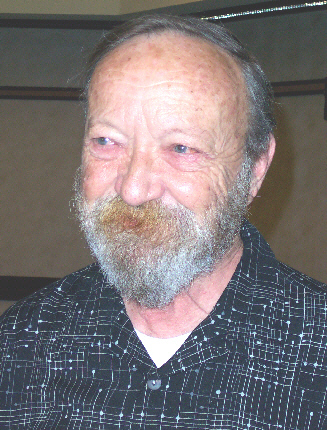
I came back from Yugoslavia in 1952 or 1954 (I can't remember which), but I was over there for almost every year, and, for some reason, decided to teach Ličko kolo. I thought it would be fun to teach people the kind of dance where you don't need a record. The dance is very old, and at one time (pre-World War II) had many variants all over Lika.
According to old-timers, the main function of the dance was to demonstrate and test the strength and stamina of the young people. In particular, the suitability of marriageable young women was judged by their ability to endure the strenuous movements of the dance's fast part which, as done by natives, can be very strenuous.
The historic formation was a circle of dancers, alternating mixed man-woman-man-woman, the couples in each case being sweethearts or engaged pairs. The dance was always done without instrumental accompaniment – the first part accompanied by dancers' singing, and the second part of comparative silence, the footfalls of the dancers being the only "audio" element besides shouts and the commands of the leader.
In an older form of Ličko, the leader played the role of "dance director," shouting out commands for all the dancers to perform certain standard step patterns; failure to perform them up to snuff meant possible ejection from the circle!
Part one of the dance started out with an ambling, almost casual walking step moving left (clockwise), three steps left and one step more or less in place, to the singing. When the song finished, the dancers "shifted gears" into the fast, high energy Part II. After World War II, the old versions of the dance had pretty well died out, and a simpler form prevailed, in some places called either Ličko kolo or by a new name, Djikac; (JEE-kahtz, jumping).
At Maine Folk Dance Camp, I taught one of the favorite songs from Lika, Pjevaj mi, pjevaj (or, in local Lika dialect, Pivaj mi, pivaj) and taught the dance, Ličko kolo, using that part for the slow, opening part. I also taught two or three variations for the fast Part II (in other words, pretty much as I had witnessed in Stanići and also as it was done in Upper Michigan by descendants of immigrants from Lika whose parents had come there to work the copper mines. A little later, Bob Liebman and Elsie Ivancich Dunin taught more elaborate, older versions of Ličko kolo around the country, with odd calls and many more variations.
Folk dancers here had never danced a European dance without instrumental accompaniment before, and fell in love with it. It captured a special place in the United States folk dance scene which it still holds today, although natives from Lika might be puzzled at the aura of near-reverence or "mysticism" that surrounds it here. The song/dance took on different meaning among the folk dancers than it had with the Yugoslavs – because it was silent. Psychologically, the word "silent," is pungent and full of power in our society. For example, "let us have a moment of silence, please" in memory of so-and-so, or "the mob fell silent at...." The word "silent" in English is loaded with lots of baggage that a good translator would avoid applying to a dance. When you say "the silent kolo," there is an air of mystique, of mystery, of possible spiritual power involved. That silence kicked in American sentiments of reverence. Anything that's slow and majestic and has silences feels reverent. In contrast, when they sang in the village of Stanići, those four beats without singing did not bring any sentiments of mystique or reverence to the natives – it was just natural. They were getting ready to sing the next verse.
The step is so simple – it's just a walking step, but the silence is what proves to be the most attractive thing for American folk dancers, and yet it's attractive for the wrong reasons if you look at it from the point of view of the native who did it. Candles lit in the middle of the floor, and everybody wearing reverent expressions as if it were some sort of religious ritual – this does not match the native's reality of Ličko kolo – to them, it's just a dance. People in Lika would never understand what this is all about.
One year at Stockton Folk Dance Camp, a fellow from Lika who had made it in the grape business in California, came and watched us as we did Ličko – he didn't get into it. Afterwards, he said exactly what I would have predicted. "Why the candles?" And "That dance is nothing...you just walk and sing...why would you do it anyhow?" To add to his puzzlement were the dimmed lights, the candles, the hymn-like quality of the singing, and this rapt silence. It's only done now around the country as the final dance of the evening and they turn the lights down and light the candles.
In the recreational folk dance movement, Ličko kolo took off and acquired a life of its own. The steps themselves have changed (the natural folk process) over the years, and a purely U.S. variation of the slow step has developed: a grapevine to the left: step left, step right in front of left, step left, step right in back of left. This is a change from the traditional structure in which the last step by the right foot never crossed in back of the left; rather, it either stepped in place, very slightly to the right or straight or diagonally/right back from the center with a slight pause.
I think Ličko kolo is a wonderful point to discuss many things about folk dancing, about one culture, and what it does with the cultural traits of another culture, why and how just the idea of the interpretation...of two different cultures' interpretations of the meaning of silence. This provides a nice exercise in cross-cultural understanding without getting bogged down in heavy, philosophical and/or abstract discussions.
Printed in Folk Dance Scene, April 1997