|
Folk Dance Federation of California, South, Inc.
|
|
CLICK AN IMAGE TO ENLARGE

|
Ajde Karagouna, Karagouna! |
Come, Karagouna! |
So starts a Greek song we Californians learned to dance to. There are several versions of the song; and the dance we learned was somewhat choreographed. So too are several other versions of the dance that have been introduced since then. So what is the right dance? The problem is that Greek dances are generally free-form, starting from a rather simple base well known among the residents of each particular village and each village does things a bit differently. In fact, they instantly know you're not from their village if you don't do it their way! But let's go back to the beginning: Who or what is "Karagouna"?
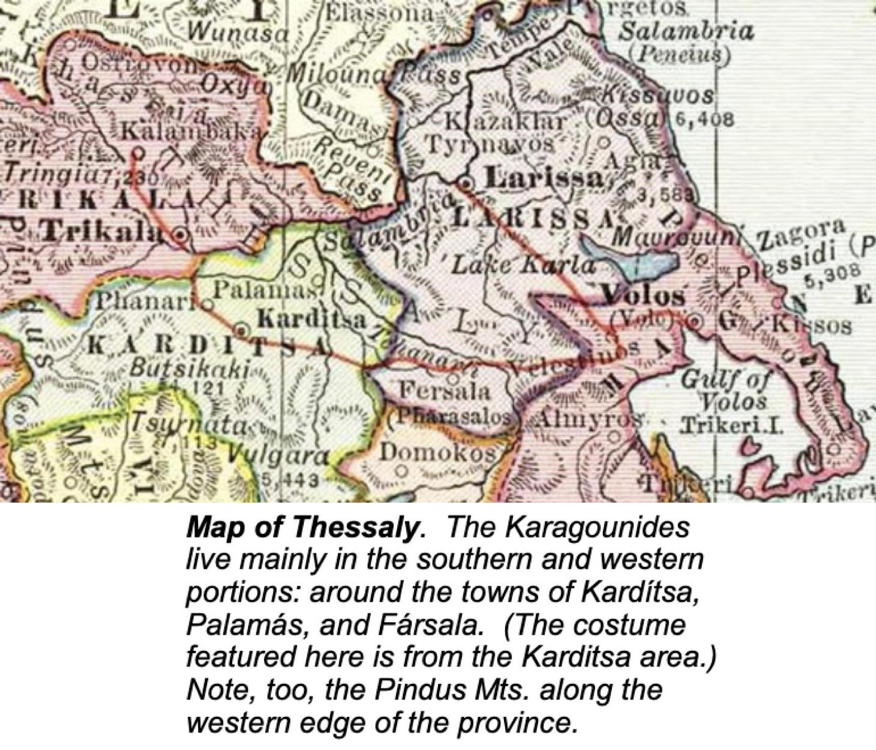
Karagoúna (feminine singular), plural Karagounídes or Karagounis, refers to a particular group of people farming in Thessaly, the largest agricultural plain in Greece (see Maps above). They form most of the population in the areas of Karditsa, Sofades, Palamas, and Farsala. Those who were shepherds used to move their flocks to the cooler, greener Pindus Mountains to the west for the summer months, setting out on St. George's Day (April 23), then returning in the fall so their sheep and goats could glean and fertilize the family grain fields all winter. Thus the love-sick singer of our song, in some versions, complains that the Karagouna girl hasn't written to him – clearly one of them is away:
|
Ajde perase ena kalokeri |
Come, one summer has passed |
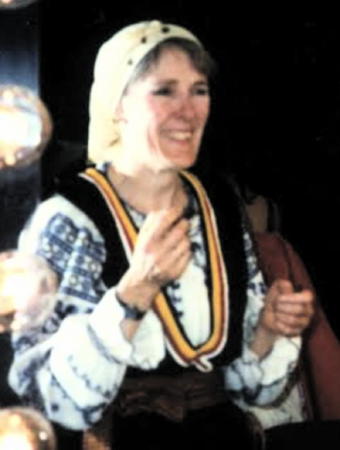
In another, he offers to sell his sheep or goats to buy her finery, such as a silk sigoúni. Sigoúni, sigoúnia, or goúna, refers to a type of heavy felted-wool overcoat forming part of the costume of girls in most of Greece, especially in winter. Indeed, the most commonly suggested etymology of Karagouna is "black coat," gouna being "coat" and kara the common Turkish word for "black." The Karagouna costume is built around a sayiá (or saia, saya – a traditional long outer dress), and in referring to these garments the singer is alluding to the fact that the Karagounis tended to keep to themselves and continue their ancient peasant traditions. The girl is instantly recognizable by her beautiful and quite distinctive handmade costume (photos a and b).

Many theories have been put forward as to the origin of this distinctive group: that they were originally transhuman shepherds related to the Romance-speaking Vlachs, or that they migrated from Albania as Arvanites. But they speak only Greek (unlike the Vlachs and Arvanites), even if a non-mainstream dialect of Greek. No one can agree on whence they came-perhaps genetic information will eventually give more solid clues.
The "Karagouna" dance(s) we do, and the steps, are certainly based on the dances done by the Karagounis. But those who bring us such information recognize that our groups function very differently from dancers in traditional Greek villages. There, everyone knows the basic step for a given dance (which may have several possible tunes), and also some variations which can be done as wished – usually by the leader, who may have paid the musicians and thus has the right to do anything he wants. If he is feeling full of kéfi (a wonderful Greek concept referring to feeling really good, and ready to – how shall I put it? – let off steam, show off, kick up a storm, have a ball,...), he can do as many variations as he likes, and the rest of the line can either imitate him or continue doing the basic steps. But in our California groups we are unaccustomed to instant improvisation and feel much more comfortable and unified if we are all doing the same thing at the same time. So our teachers helpfully pre-choreograph known steps into a specific order for us. (This difficulty is most apparent with Rom (Gypsy) dances, for there the dancers make up almost everything as they go along, each starting from his or her own favorite moves.) Fortunately – and this may be part of why the dance has lasted here – the music is in a fairly slow 2/4 rhythm, suitable for simple syrtós, sta-dío, and sta-tria steps as well as other steps specific to this dance.
And of the various words in the songs, at least one version seems to end happily:
|
Am'pos da, am'ti da, sto parathyri s ida. |
Yes indeed, of course: I saw you at the window. |
Printed in Folk Dance Scene, August 2021