|
Folk Dance Federation of California, South, Inc.
|
|
CLICK AN IMAGE TO ENLARGE
 Throughout its history, Poland's borders changed often. In 1492, when Columbus was discovering America, Poland – then united with Lithuania – was the largest country in Europe. For 200 years the great power of the Polish-Lithuanian Commonwealth flourished. Unfortunately, from the second part of the seventh century on, Poland was invaded by the Turks, Swedes, and Muscovites. In 1795, finally partitioned by three neighboring powers (Russia, Prussia, and Austria), Poland disappeared from the map of Europe as an independent state. After 123 years of constant struggle for freedom, Poland regained independence in 1918, at the end of World War I. Then in 1939, World War II broke out. Although the first to fight against Nazi Germany, Poland fell under Nazi and then Communist rule. Since the collapse of the Communist regime in 1989, Poland has once again become a free and democratic country.
Interestingly, all this troubled history helped to preserve Poland's folk culture. In order to retain their national identity, the Polish people fiercely clung to their language and to their old customs and traditions, including folk dance, music, and attire.
Poland is situated in the center of Europe. It has often been called a cultural "bridge" or "crossroads" between eastern and western Europe, as well as between the Scandinavian and Danubian countries. This central position brought cultural interchange between Poland and foreign countries in many ways including royal intermarriages: Poland had several foreign kings. During the 17th century, Poland had three monarchs from the Swedish dynasty of Waza. During the 18th century, two Saxon Kings ruled the country. Moreover, several Polish princesses married foreign monarchs. The oldest and most notable foreign influence is seen in the mountain regions of southern Poland where nomadic Wallachian shepherds wandered from the Balkans through the Carpathian mountains in the 15th and 16th centuries. Their imprint of a lively and vital pastoral culture is seen in all the people whose lands they crossed, including the Polish mountaineers.
 Foreign influences eventually change Polish dance traditions and men and women started dancing in couples. Originally, Polish village dances were done in circles or lines, the original formation known to the Slavic world. Later foreign influences came mainly from the west – Poland often looked in that direction for models. As a result, some Polish folk dance steps are based on the polka from Bohemia, the waltz from Austria, Csárdás-like steps from Hungary, Cossack-like style, the Kolomyika-style steps from Ukraine, and dance patterns characteristic of the Baltic sea area. Typically, the Polish people transform many of these foreign influencers to match their own style.
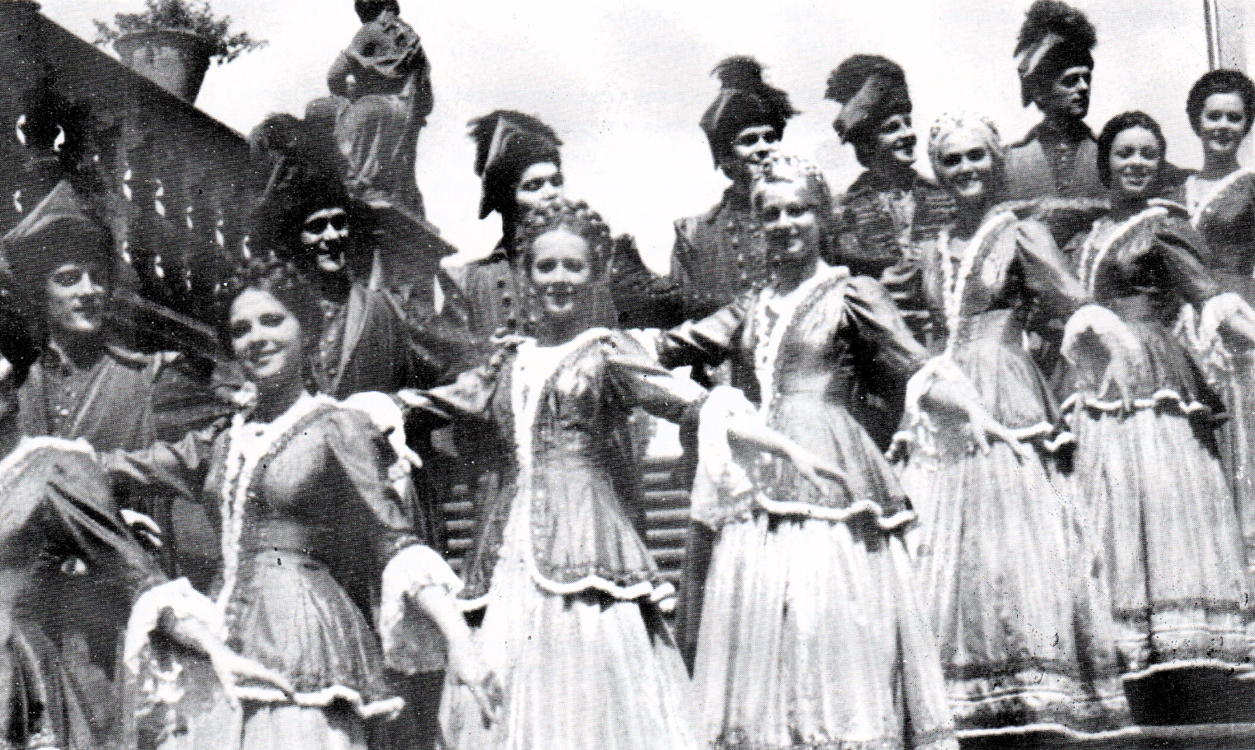 Couple dances, as compared to line or other circle dances, give the Polish dancer more room for improvisation. A talented and exuberant dancer often improved the melody on the spot. He would sing his tune to the musicians, who would then play it. The dancer paid his money to the band and, with his partner, led the other couples around the room. These actions are remnants of ancient rituals done either around a central figure (probably a God) or honoring a leading couple (such as newlyweds). The singing done by the lead dancer has been preserved until today in the characteristic songs or przyśpiewski, which accompany most demonstrations of Polish folk dancing.
Although most of the dances are done in pairs, the man definitely is the leader and the "star" performer. The woman is his support, audience, and enhancement. The man's dancing is individualistic and competitive and when he dances, his entire body participates – his legs, arms, head, and even his eyebrows. Under the inspiration of good music, he might spontaneously invent some steps. He attempts to show off his skill, strength, and agility (although he often cannot perform some of his feats without his partner's strength and support).
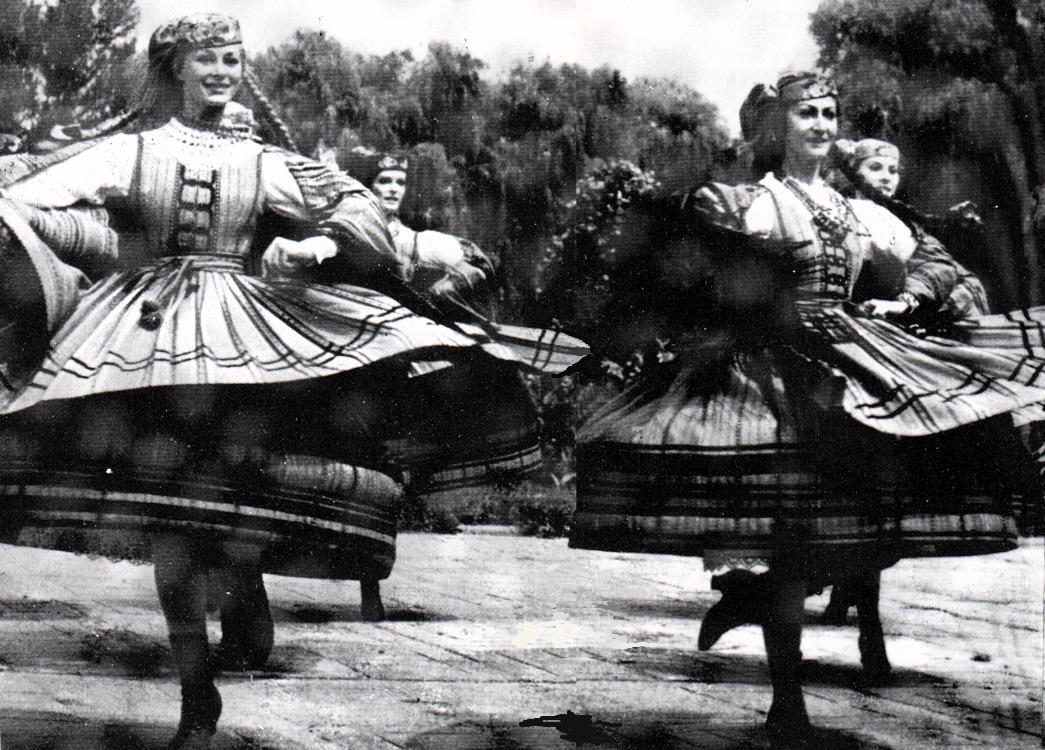
Attire, decorations, "props" all influence the style of Polish dancing. A particular cut of coat or jacket, the type and the amount of fabric used, or the shape and weight of a headgear, for example, often have a limiting effect on certain movements and figures, as well as some props such as a handkerchief, a whip, a stick, a broom, or a hatchet which are necessary accessories to perform some dances or dance movements. The costume is an integral part of the dance. Women's colorful wide skirts twirl and their white petticoats swish. The striking array of colors of the woven materials shimmer. The leather boots with metal heels pound out live rhythms. Ribbons fly feathers on men's hats and sweep the floor or the ceiling, necklaces and ringlets jingle, sequins sparkle, and embroidery dazzles the viewer with color, further enhancing, embellishing, and enriching the dancing.
CATEGORIES OF POLISH DANCE
Polish dance falls into two categories: national and regional.
REGIONAL refers to dances which originated in specific regions of Poland. Often, rivers, mountains, thick forests, or swamps form natural boundaries between various regions, making communications between them limited. This geographic isolation allowed the development of characteristic specific each to develop in always of life, including folk dancing styles. This isolation also helped to preserve these regional differences.
Overtime, communication increased between these regions, leading to interaction and exchange of cultural elements with neighbors. Melodies and lyrics of songs and dance steps started to migrate. As a result, different regions came to have similar dance patterns. Now, regional limits are in the minds, hearts, and traditions of the people involved.
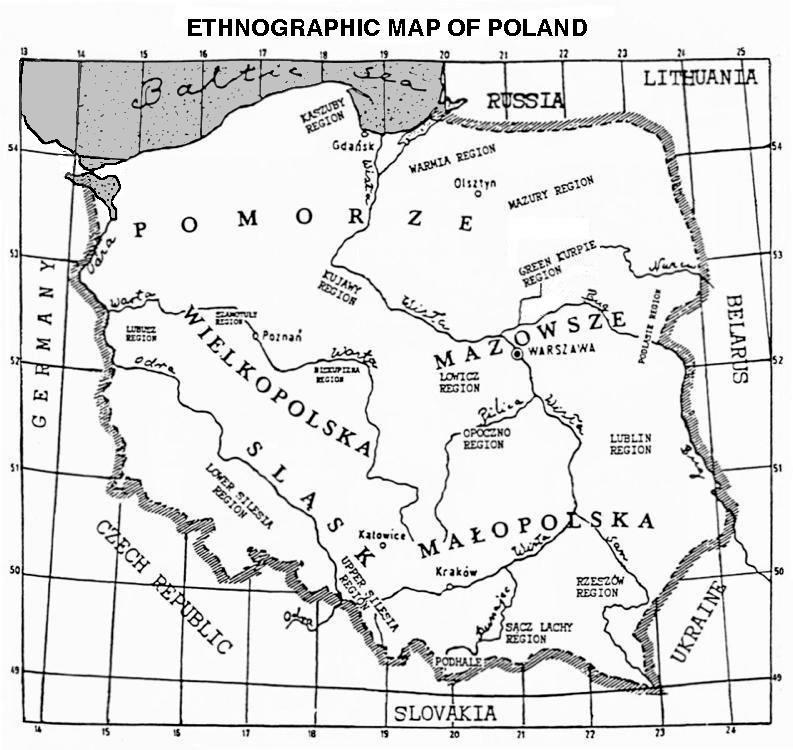
The different FOLK regions are grouped or "registered" into five major ethnographic/geographic/historic areas. These major areas (or macro regions) correspond roughly to the territories inhabited in the 9th century by the Slavic tribes of which Poland was created.
These major areas are:
- Mazowsze, in the center of Poland;
- Malopolska, on the upper Wisla River;
- Śląsk, on the upper Oder River;
- Wielkopolska – Greater Poland, on the middle of the Odra and Warta Rivers;
- Pomorze – Pomerania, on the shore of the Baltic Sea.
There are approximately forty folklore regions in Poland and many of them have subregions. Because each region or subregion has its own characteristic dances, their exists a large number and great variety of Polish regional folk dances. However, they all have some characteristics in common. One is the music, which may be slow, medium, fast, or of a variable tempo, but it always is in either 3/4 or 3/8 and 2/4 or 4/4 meter. The triple meter is predominant in central Poland while the even meter is popular in eastern and southern parts of the country. In the remaining parts of Poland, both meters are danced. As a result, to match the triple meter there are steps of the waltz or of the mazurka, to match the even rhythm, there are steps based on walking, running, galloping, skipping, hopping, or the polka.
The regional dances can be divided into several groups:
- Ritual dances that display remnants of ancient religious or wedding ceremonies;
- Dances that were created to accompany a particular song;
- Dances that imitate
- the action of cultivating the soil,
- gestures of a craftsman, or
- movements of a field or farm animal.
- Dances that were derived from a game;
- Dances from villages closer to political or geographical borders that show characteristics of the neighboring nations: Sweden, Germany, Slovakia, Czechia, Hungary, or Ukraine.
NATIONAL DANCES make up the second category of dances from Poland. Although they originated in villages of specific districts of Poland, they are regarded as "national" because of their popularity all over the country and because together they truly reflect the multifaceted national character. As each region adopted these national dances, it added its own characteristic variations and styles. As a result, the dances have many steps and figures.
The national dances are:
- The Polonez (origin: the Wielkopolska region),
- The Mazur (origin: the Mazowsze region),
- The Kujawiak (origin: the Kujawy region),
- The Oberek (origin: central Poland), and
- The Krakowiak (origin: the Krakow region).
With the exception of the Krakowiak, that is danced to even 2/4 m music, the remaining four national dances are danced in 3/4 or 3/X meter, the favorite and beloved rhythm of the Polish people.
Village folk dances moved from the villages to other social strata. First, the landed Gentry all over Poland adopted them. Then, all but the Oberek were passed from the manor folk to the magnate's courts and, and eventually to the royal castle. Within each of these social groups, the dances were transformed, polished, embellished, and enriched with additional steps and figures. Finally, during the 18th and 19th centuries, most of the Polish national dances became fashionable at the European courts and even at the White House in Washington, D.C. During the 19th century there occurred another interesting stage in the development of the national dances: western European dance Masters created new ballroom dances modeled after the Polish ones. The best examples are the Mazurka and the Polka/Mazurka.
In modern times, old folk ways, including dance, slowly disappeared. Folk dancing in its pure form can only be seen in a few isolated areas of Poland (e.g. Podhale and Kurpie), many at weddings. Luckily there has been a tremendous effort in Poland, especially since the end of World War II (1945), to revive and preserve the old vanishing folk culture of the land. This effort has relied heavily on the older population, such as native artists, who have been encouraged to show their skills and singing, dancing, constructing and playing old instruments, weaving, embroidery, pottery, wood carving, or painting, and to pass their skills on to the next generation. Furthermore, many folk culture books have been published, the production of folklore and craft encouraged, special teachers and choreographers trained, and many amateur performing ensembles formed. These ensembles, dressed in authentic regional garb (or good facsimiles) not only create the old dances and songs, but often reenact the old customs and rituals for audiences. Poland also has two national state folk ballet ensembles: Mazowsze, founded in 1948, and Śląsk, founded in 1953.
Abstracted from Ada Dziewanowska's text, Polish Folk Dances and Songs, published in 1997 by HypocreneBooks, Inc. in New York.
Printed in Folk Dance Scene, December 1998