|
Folk Dance Federation of California, South, Inc.
|
|
CLICK AN IMAGE TO ENLARGE
According to Edward a Berlin in his book, Ragtime: A Musical and Cultural History, "From its earliest days ragtime has been associated with dancing. Performers who sang ragtime lyrics on the minstrel stage also danced to its rhythms. As the music moved to the ballroom, syncopated ragtime marches, two-steps and cakewalks coexisted with unsyncopated versions of the same steps. "In some cases, the dances themselves acquired the ragtime label. Throughout the period there are references to specific steps being "rags" and to "ragging" as a style of dancing. More often, however, dances were simply associated with ragtime music. While almost any duple– or quadruple–meter step could be done to the music, some dances had an especially close affiliation with ragtime.
Ragtime sheet music frequently listed the "appropriate" dances to accompany the music. The sheet music, itself, is an important source of information on ragtime ballroom styles; a year-by-year survey of the sheet music reveals the gradual change changes in fashions.
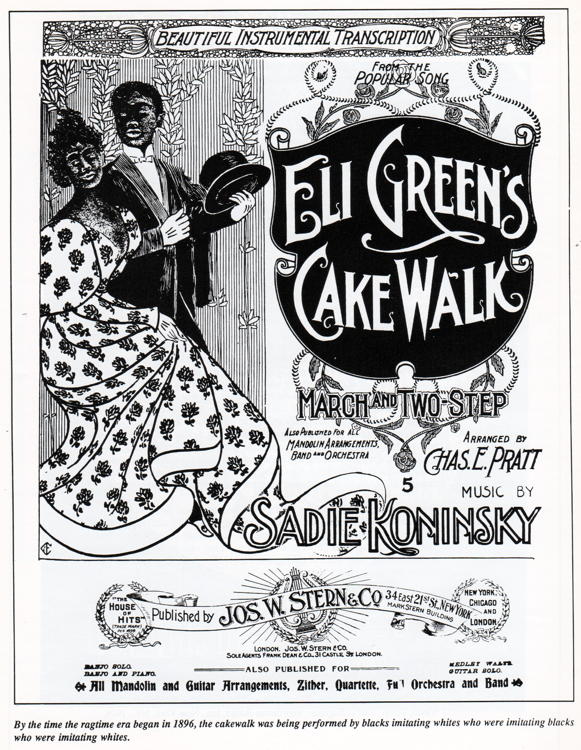
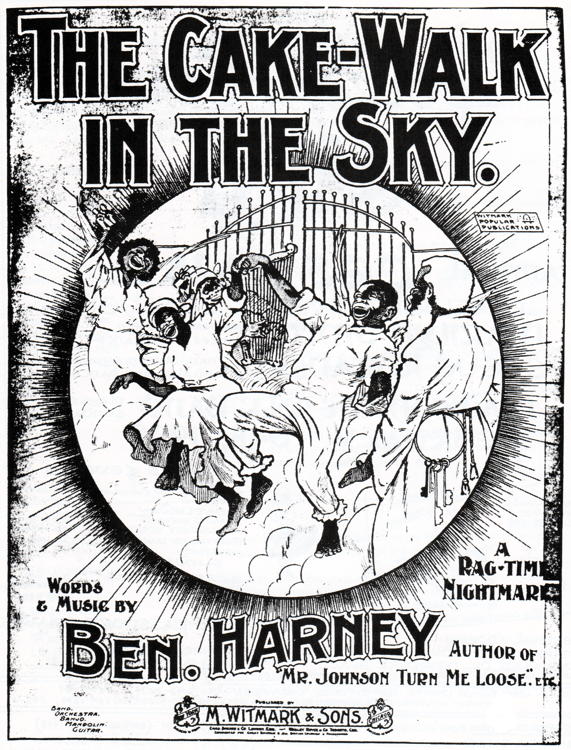 The dances named on the earliest ragtime sheet music are the cakewalk, march, and two–step. An indication of the lack of musical distinction made between these dances is that all, or any combination of the three, maybe be listed on a single piece of music (for example, "A Rag-time Classic. Characteristic March Two-Step and Cakewalk," 1903). Sometimes another dance, such as the polka, is also included.
The cakewalk was a grand-promenade type of dance of plantation origins in which the slave couple performing the most attractive steps and motions would "take the cake." The dance enjoyed a dramatic revival shortly before the establishment of ragtime. Spurred by exhibitions and contests in the early 1890s, interest in the cakewalk eventually brought this plantation dance to the ballrooms of the United States and Europe, where it retained a following into the first decade of the 20th century. The basic music for the cakewalk was the March.
The cakewalk was the first of three main ragtime dances to disappear from the sheet music. It died out by 1904. The March began to decline in 1908, and the two–step in 1911; both dances, though, lingered on until the mid 1910s.
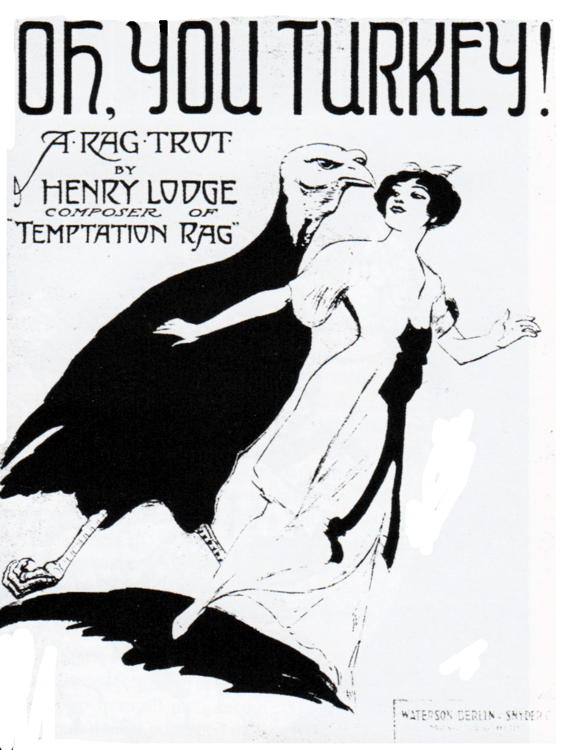 In the second decade of the century, new dances were cited on ragtime sheet music, but without the persistence of the earlier steps. The turkey trot had a short life, from about 1912 to 1914; the one step in the foxtrot were both prominent by 1913, the former lasting until 1917, the latter having an unmatched longevity. The slow drag was mentioned throughout the entire time. With less consistency, many other dances were associated with ragtime. The local version of Scott Joplin's "Ragtime Dance" is especially interesting for its inventory of dances, some of which do not appear in other sources. It is possible that the less familiar dances had a more restricted circulation and were known primarily in the Black communities. The dances mentioned are the "ragtime dance," "cakewalk dance," "slow drag," "world's fair dance," "cleanup dance," "Jennie Cooler dance," "rag two step," "back step prance," "dude walk," "stop time," and "Sedidus walk."
Despite the variety of dance names appearing in Joplin's piece, almost all of the music retains the same rhythmic character. Only the "stop time" and "Sedidus walk" use music of a different style – "stop time" music, which appears in frequently in published ragtime. It was not until the second decade of the century, with the parents of the foxtrot, that a major ragtime-related dance was again linked with music of a different character. The rhythmic patterns associated with the foxtrot tended to replace the accepted modes of ragtime syncopation, and this process ultimately led to the disintegration of ragtime as a distinctive musical type.
The ragtime time era came to a close shortly before 1920 with the advent of the "jazz age." The end came gradually as the characteristics of ragtime were absorbed by jazz; for a while the two terms were freely interchanged. At last, supplanted by a newer wave of syncopation, ragtime seized to be the emissary of the American popular culture.
Bibliography
Berlin, Edward A., Ragtime: A Musical and Cultural History, University of California Press, Los Angeles/Berkeley, 1980.
Printed in Folk Dance Scene, January 1998