|
Folk Dance Federation of California, South, Inc.
|
|
CLICK AN IMAGE TO ENLARGE
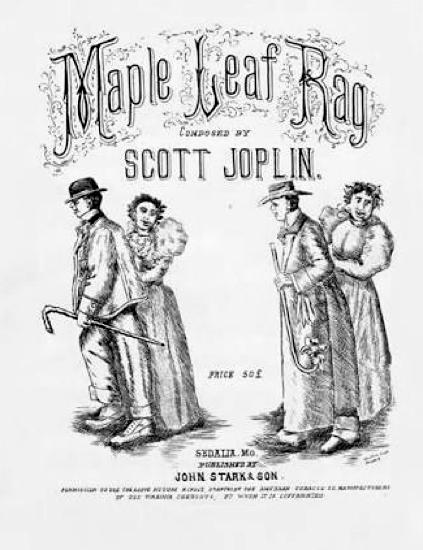 Ragtime defies precise musical definition. It is best defined by the types of music that are included in the term. This forms a wide and constantly changing body of music. The concept of ragtime is not the same for Joshua Rifkin as it was for Scott Joplin. Some considerate it a primitive form of jazz while others considered it a type of folk music. In fact, ragtime is both of those and more. It's roots extend back into the last century as America's first and most unique contribution to the world of music.
The word "ragtime" is thought by many to come from the concept of "ragged time" – tearing time apart. Other possible sources of the term are: the term "to rag," meaning "to tease," and the music does just that. It's full of surprises – unexpected shifts and rhythm and harmonies.
Musically, it is important to differentiate between rag and ragtime. A rag, strictly speaking, is an instrumental, syncopated March and follows the same formal conventions as the March. Ragtime time, however, could be said to apply to almost any music that is syncopated. To rag a piece is to play it in syncopated style, so ragtime includes instrumental rags as well as such musical forms as the rag song and Dixieland.
Although syncopation is essentially of African origin, it's combination with the European musical system accounts for the uniqueness of ragtime – a music of great contrast. "This was the first significant musical innovation to evolve from the cultural interchange brought about by slavery in the United States." So ragtime is, at least in its inception, Afro-American music.
Today's ragtime is composed within the European written framework – a national system based on measures and divisions of measures. African music, on the other hand, is not notated. It is transmitted arually, learned by hearing.
 Additionally, African music is polyrhythmic. Unlike European music, African music gives at least as much emphasis to rhythm (instruments without pitch, such as drums) as it does to melody and harmony. As a result, much African music includes a number of sophisticated, complicated polyrhythmic patterns. To an extent, polyrhythms have been translated into ragtime, modified so that one rhythmic pattern dominates.
Another African musical element Inc. in ragtime is the emphasis on the percussiveness of the music, which results in a great variety and subtlety of accents. So, the ragtime is based on the traditional European major and minor scales, much of the music shows a preference for the pentatonic scale (achieved, for example, by using only the black keys on the piano), which is more prevalent in African music.
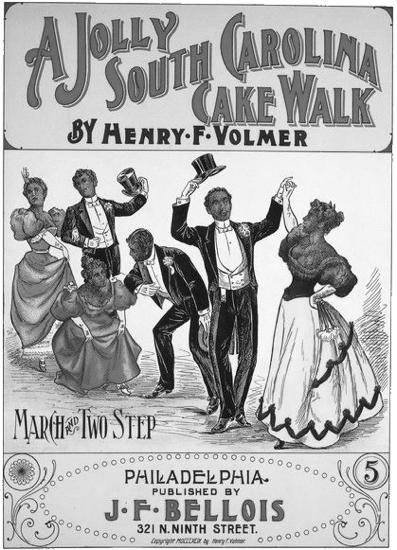 The above comprise only one facet of the contrast between these two musical heritage Ages. The fundamental differences go much deeper. Many elements of African music do not translate into European terms because of the cultural differences in the function and conception of music. In African societies, there is no separation between the musician and the audience. Everyone participates in musical events, through dancing, singing, or playing. And the music is not simply what is heard, it is the whole performance. Gesture and movement is as important as the sound.
European musical in tradition, by contrast, tends to isolate the participants from the audience and the participants from the functions. The artist creates music for a separate audience. The music is often transmitted through the medium of notated music, so emphasis is placed on the written note rather than the total live performance that is so much part of the Afro–American musical tradition. This is also roughly the difference between classical and folk music, and this is where ragtime sits, straddling the fence between the two.
The roots of ragtime extend back in time to the era of slavery in the United States. The slaves, barred from performing pure African music, performed European music in African style, improvising on it and frequently syncopating it. The large body of Afro-American music at the time was pure folk music, having evolved from the daily lives of the people. Most of it fell into one of three categories: religious music, dance music, and work songs.
RELIGIOUS MUSIC evolved into the spiritual which became an integral part of African-American religious camp meetings. The camp meetings also incorporated a purely African form of dancing called the "ring shout." In the ring shout, crowds of people formed huge circles, sang spirituals, clapped their hands, and danced in a shuffling movement. These camp meetings and ring shouts lasted well beyond slavery and into the 20th century and directly influenced a variety of ragtime composers.
DANCE MUSIC was played mostly on fiddles and banjos. Every plantation had at least one fiddle player to play music for the plantation dances which took place on almost all special occasions. After the Civil War, hundreds of the liberated Black musicians wandered the country picking up work and exchanging music ideas in the process. Early ragtime was strongly influenced by these.
Work songs are generally considered to be primary sources for the blues, not ragtime. Many work songs directly influenced the rag writers. Work songs and Negro dances were disseminated by the Blacks who were employed as stevedores along the eastern seaboard, the Gulf Coast, and the many eastern rivers. They generally worked under terrible conditions, but were known to sing as they worked and danced when there was nothing to do. Their improvised music found its way up and down the various waterways of the United States.
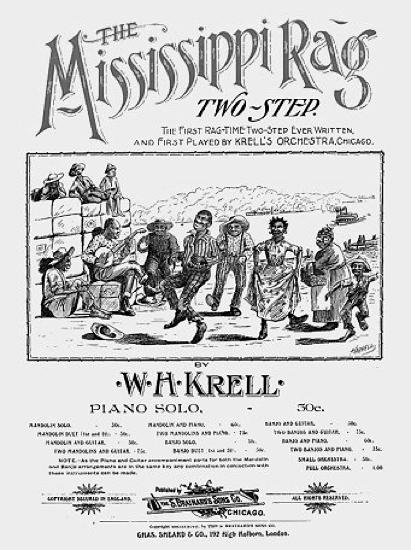 "Real ragtime" developed in the areas surrounding the Mississippi River, especially around St. Louis St. This city, located on the travel routes of both the Mississippi river and the railroad lines, provided ground for the merging of many musical traditions. The population included a large German-English community (European classics), a Spanish-speaking population from Mexico provided a Latin flavor, and the black stevedors of the river and itinerant musicians provided the Black music. These peoples met and merged their music in the tenderloin district, a place where boundaries were unknown. Other centers were Kansas City and New Orleans.
Ragtime hit New Orleans BIG. Newspapers of 1898 showed ragtime concerts and "monster white cakewalks," in which "dancers impersonated the colored population with the use of burnt cork." The music was also performed in some less reputable establishments (houses of prostitution, etc.), where it flourished. Musicians came and jammed, played for tips, and generally improvised to all hours of the night.
An important tradition of the minstrel-show era was the "11:45" a.m. parade and concert, during which the entire cast, including the band, marched through town playing the popular marches of the day as a promotion for the evening show. Marches were particularly popular during the 1890s and eventually came to be the music used by dance masters for the new two-step which was to replace the waltz as the popular dance of the day. The march rhythms, too, found their way into ragtime music. Instrumental rag became an established musical form in the late 1890s.
Ragtime was first published in 1896, though it was part of the underground black subculture long before that date. It was proceeded by two related musical fans: the cakewalk and the "coon song," Both both outgrowths of the minstrel show.
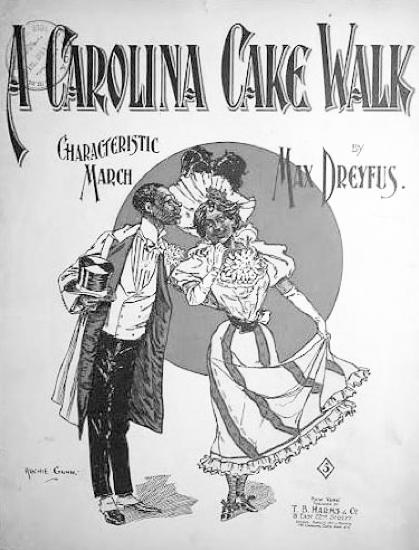
Cakewalks are thought to have originated as early as 1840 with slaves who dressed up in "high fashion" and mimicked the formal dances of their masters. Their caricatures were picked up by white performers and used in the grand finale of the minstrel shows. Later, Black's performing in the Black stereotype mold of the white menstrual shows picked up the dance. By the time the ragtime era began in 1896, the cakewalk was being performed by Blacks imitating whites who were imitating blacks who were imitating whites.
The peak of popularity for the cakewalk came around 1892, when cakewalk extravaganzas were being held all over the country. Dressed in fine clothes, each couple would march in, two by two, doing the high-stepping strut. Then couples took turns making up their own variations. At the conclusion, they would high-step in a circle and file out.
The most important single event in terms of bringing together all of the influences on the development of ragtime was the world's Colombian Exposition in Chicago in 1893.
There was a world of entertainment at the F Marshallair, ranging from "primitive" African music to the martial strains of the Sousa band.
THE RAGTIME ERA
 Much of the Black music of the time could be characterized as feigning happiness while masking underlying misery. The white music either lacked this duality or, in some cases, faked it. For the whites, ragtime was simply "happy colored music." For the Black composers, it was much more – an expression of the alien nation that came from being uprooted from communal plantation life and into a cold, mechanized industrial age. Blacks and whites could both relate to this alienation.
Black ragtime might be seen in four different lights: first, as a joyous and creative dance and entertainment music reflecting the background of men raised in the Black subculture who could now bring their music to the larger public; second, as parody juxtaposing the inane grin of the minstrel show "coon" against the underlying misery of an oppressed race; third, as an expression of triumph pending the old law and order against the new freedom from slavery; and, fourth, as an expression of the loss of innocence, placing the old Black folk music in a new, mechanized content.
Something about this ragtime music has made it "classical" – classical in the sense that it has truly stood their test of time.
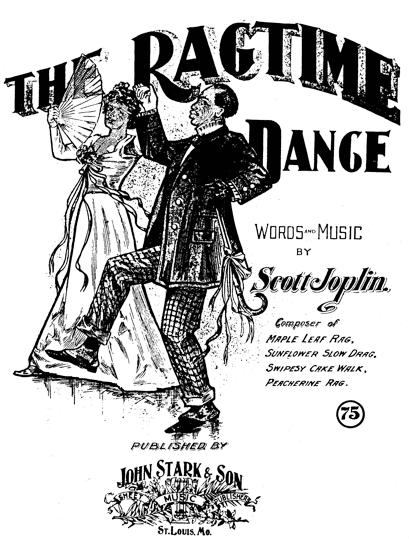
Of the numerable ragtime composers, only one is particularly well known to non-aficionados – Scott Joplin. He led what could be considered the first "wave" of ragtime music, which is considered "classical" by most ethnomusicologists. According to Teri Waldo, "Joplin relates his music to 'the dance.'" The ragtime dance (one of Joplin's compositions), IS dance music – it has directions for dancing. Ragtime was overtly functional as music for bodily movement. It was a highly physical celebration of the sensual present. "Joplin's clear goal, it seems to me, was not to abandon and forget this aspect of it but to have it accepted. He was not working from folk music to concert music nor from the saloon and bardello to the concert stage. He was working toward the goal of tearing down barriers, a goal that is still elusive. Ragtime came from the lusty, unsophisticated folk ways and finally made it to the ranks of legitimacy." His music featured surface gaiety juxtaposed against an underlying rigidity and sadness. Tension, achieved in a variety of ways, distinguishes the works (e.g., use of rhythmic clashes of syncopation, irregular stopping, and starting of syncopated phrases, dispersed with simple, unsophisticated phrases). Also characteristic is the constant shifting between full harmony and single-note or two-note passages, and unexpected changes of key.
Commercial ragtime began in the 1890s when live music was the norm for entertainment. Published sheet music was intended for sale to people who would play the music at home. Though material sprang up from all parts of the country (New Orleans, Memphis, and other parts of the South), most published rags came out of New York, especially in the later years of the ragtime era (1910). Since that time, ragtime has enjoyed several rivals:
1940s revival – ragtime as jazz,
1950s revival – ragtime as honkey-tonk,
1960s revival – back the roots,
1970s – the Joplin Revival.
BIBLIOGRAPHY
Berlin, Edward A. Ragtime, a Musical and Cultural History. University of California Press, Berkeley and Los Angeles, CA. 1980.
Blesh, Rudi and Harriet Janis. They All Played Ragtime. Oak Publications, NY. 1971.
Waldo, Terry. This is Ragtime. Hawthorne Books, Inc., New York, NY. 1976.
Printed in Folk Dance Scene, January 1998