|
Folk Dance Federation of California, South, Inc.
|
|
CLICK AN IMAGE TO ENLARGE
Originally, the Căluș was a Whitsuntide healing and fertility ritual which coincided with Rusali, a time when evil spirits are very active and dangerous. It was performed in ancient southern Romania's agrarian villages by the Călușarii (Western spelling: Călușari), a ritual group of 7, 9, or 11 men. In addition to being able to "cure" villagers who, through lack of observance of Rusalii taboos, become "possessed" by the Rusalii fairies, the Călușarii, through dance and mime, celebrate the welcoming of spring and "influence" nature.
The Călușarii: The Group Itself
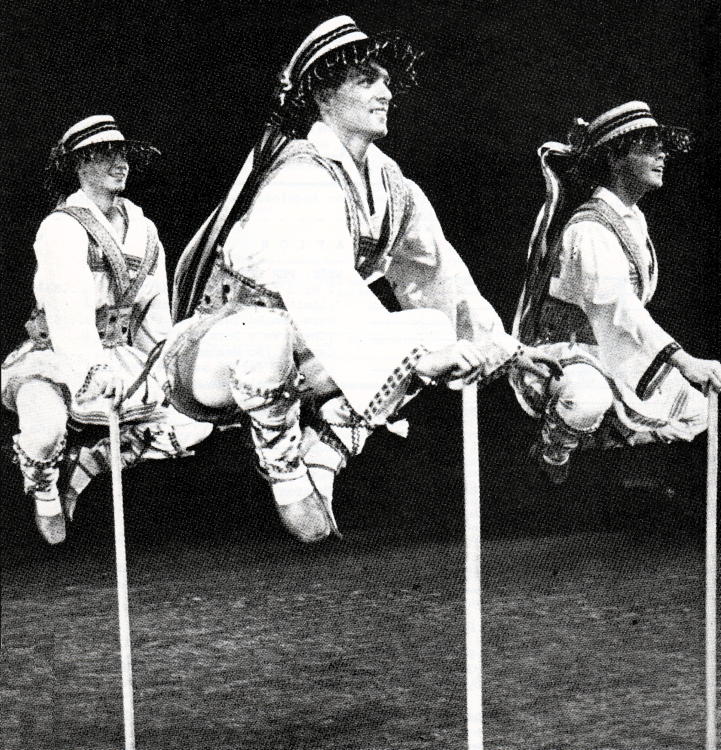 The Călușarii themselves are a select group of men, bound together through rites, oath taking, and symbolism. In addition to being the best dancer in the group, the vătaf (the leader of the group) possesses the magical charms and secrets needed for ritual ceremonies performed and for the physical and spiritual healing of the "possessed" during this time. The position is for life, and the secrets are passed to the new vătaf by the old "on his deathbed." If the old dies before transferring his secrets to the newly chosen vătaf, generally the ajutorul văta fului (the man who danced next to the vătaf in line) becomes vătaf and must learn the secrets from the vătaf of another village. The mut (mute), is also found in many Călușarii groups. Though his role is comic, communicating strictly through mime, the mut carries responsibility for many magical and ceremonial acts, as well as healing. Depending upon the village, the responsibility may be his alone or shared with the vătaf. The ajutorul vătaf fului is next in status to the vătaf, and acts as his assistant. The importance of the flag bearer is in direct proportion to the great symbolic importance of the flag itself.
Costuming
All of the Călușarii (except the mut) wear the same basic costume, consisting of white cloth shirts (hanging to the knee and embroidered at the neck, cuffs, and hem), tight-fitting white pantaloons, footless knee socks (worn over the pantaloons), wide-brimmed black felt or straw hats (elaborately beaded and sequined) with ribbons hanging to the waist from the back, and opanci. In addition, crossed leather straps are worn across the chest. Belts (with varying amounts of embroidery) carry pieces of the symbolic garlic and wormwood, and wooden sticks are carried by all.
The mut, as a character representing both male and female, amongst other dichotomies, incorporates elements of both genders into his costume. He wears an army-type jacket tucked into a skirt which is worn over baggy pants. His head is usually completely covered with a mask/hood (made of various materials), and he carries a red sword and/or a whip. He also usually wears a red wooden phallus under his shirt (!?).
Ritual Symbols and Laws
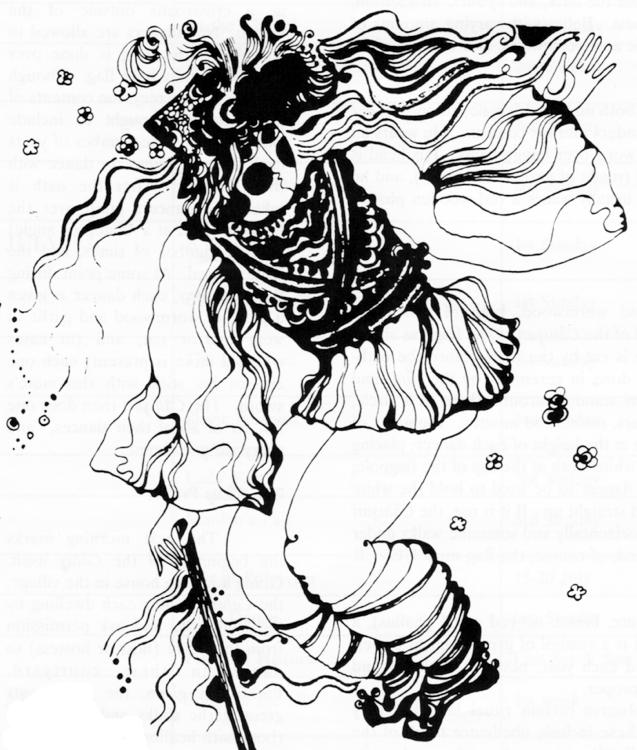 Magical power resides in garlic and wormwood, both of which are incorporated into the steag (flag), THE symbol of the Călușarii. "The flag has all the power." Enshrouded in mystery, the flagpole is cut by the vătaf before the oath-taking ceremony. Further flag preparation is done in ceremony by the vătaf and mut, with the other members of the Călușarii standing around them in a circle, complete with pieces of wormwood in their ears, noses, and mouths. Elements of flag preparation include: notching the flag pole at the height of each dancer; placing one piece of garlic and one of wormwood in a white cloth at the top of the flagpole; and cutting a red string to the height of each dancer to be used to hold the white cloth in place. The flag must always be carried straight up. If it is not, the Călușarii will tire and be unable to dance. If it is held horizontally and someone walks under its shadow, that person will sicken and die. And, of course, the flag must NEVER be dropped!
In some areas (where there is no mut, hence, no red wood phallus), a rabbit skin pulled over a stick, the cioc (beak) is a symbol of great magical power. The cioc, where used, is buried and unburied each year, never in darkness and always at a crossroads far outside the village proper.
During Rusalii, the Călușarii must observe certain ritual laws lest they become possessed by the Căluș. Generally, these include obedience to all of the commands of the vătaf, the maintenance of all Călușarii secrets, and sexual purity during this time. There is always an odd number of Călușarii in the group, which forms and disbands in total silence. It is also important that no member of the Călușarii be alone during this period.
Sequence of Events
The events of the Rusalii can be broken down into:
1) Preparation
2) Flag Raising and Oath Taking
3) The Căluș Proper
4) Unbinding of Căluș and Disbanding of the Group.
Preparation
Preparation includes choosing members (generally on dance ability) and the preparation of costumes and ritual props. As mentioned earlier, the vătaf takes responsibility for preparing the flag.
Flag Raising and Oath Taking
Both ceremonies take place at a crossroads outside of the village. No villagers are allowed to attend. Oath taking is done over the horizontally held flag. Though shrouded in secrecy, the contents of the oath are thought to include ritual laws and the number of years each dancer pledges to dance with the Călușarii. After the oath is taken, the dancers jump over the flagpole (held at a 45-degree angle) an odd number of times, and the flag is raised. At some point during the ceremony, each dancer is given a piece of wormwood and garlic to wear and/or eat, and (in cascs where a mut is present) each one crosses his stick with the mut's sword. The Călușarii then do one full set of all of their dances, and everyone goes home.
The Căuș Proper
The next morning marks the beginning of the Căuș itself. Going house to house in the village, the Căașularii enter each dwelling by the front gate and ask permission from the gazda (host or hostess) to dance in their courtyard. Permission given, the gazda puts green garlic stalks and wormwood (both with healing and prophylactic powers) on a plate, and a block of salt (a fertility symbol). Next, the mut (when present) draws a circle with his sword around the dancers, making the circle sacred. Beginning with a relatively slow first dance, chimarea Căașului, the dancers proceed into the Jocul Călușariilor (the Dance of the Călușarii), and continue to dance all day, moving from courtyard to courtyard until sunset. Dances done by the Călușarii themselves alternate between plimbarea (walking figures done counterclockwise or clockwise around the circle) and miscari (virtuoso figures danced pe loc [in place]). While dancing, the Călușarii will shout in rhythm with the syncopated music, but there is no singing accompanying the dances. In some villages, dramatic plays follow the ritual dances. Next is the Hora Călușului, an obligatory hora from the village's repertoire of dances. Included in this part of the Căluș is dancing over children (to ensure strength and agility, and the buying and/or stealing of wormwood and garlic. This part of the festival is perhaps the most prophylactic, in that the villagers have physical contact with the Călușarii, believed to impart immunity to the people. At the end of the Hora Călușuli, the Călușarii, are paid for their efforts by the gazda.
During the Căluș proper, the Călușarii from one village will sometimes dance at several villages, particularly when these other villages lack their own Călușarii. If a group meets a rival Călușarii when dancing in another village, the two groups must "fight" in a dance competition to determine which is the better group. Judged by the villagers, the losing group is excluded from dancing in that village for a certain period of time. To add insult to injury (and bring peace), they must also provide drink for all present. This is the aspect of the Căluș most commonly found in Romania today. At the folklore festival in Deva, the Călușarii of Geoagiu, Sarmizegetusa, Romos, Roiu, many villages in Hunedoara county, and ensembles from Alba, Sibiu, Brașov, and Caraș-Severin compete, each trying to outdo the other in dance virtuosity and originality as well as with humorous satire.
Unbinding of the Căluș and Disbanding of the Group
At the end of Rusalii, the Călușarii are transformed from supernatural back to their normal status, and the flag is unbound and buried. The desorocitul Călușului, or release from tenure in Căluș, occurs on the second Tuesday evening after Rusalii itself, just before or just after sunset, at a "marked" spot at a crossroad junction just outside the village. During these final ceremonies, most of the events of the oath-taking ceremony are repeated, but in reverse direction. A shaving from the flagpole and a piece of the garlic and wormwood from the flag are given to each dancer. Finally, the dancers hold their sticks against the flagpole in a starburst pattern, let go of the sticks, and run home. The vătaf buries the flag, and Rusalii is over for the year.
Bibliography
Cernŭianu, Liviu & Lascar Stancu. Romania. Calendar of Folk Events. The Publishing House of Tourism. 1974.
Kligman, Gail. Caluș: Symbolic Transformation in Romanian Ritual. The University of Chicago Press, Chicago. 1977.
Printed in Folk Dance Scene, May/June 1991