|
Folk Dance Federation of California, South, Inc.
|

|
CLICK AN IMAGE TO ENLARGE
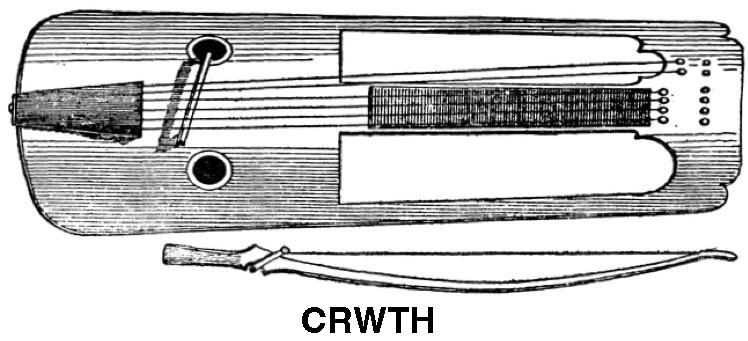 Without any doubt, the best known and most loved of all the native musical instruments of the Welsh people is the harp. There are others, including the crwth (a string type instrument of the viola family) and the pibgorn (a seven-holed hornpipe somewhat resembling a clarinet, with a reed mouthpiece and an amplifying horn at the open end), and of lesser note, a Welsh drum and bagpipes. A few examples of the old crwth, some in museums and a few now being produced by artisans in Wales, who it would appear are dedicated to bring back some of the forgotten areas of Welsh musical heritage.
As for the harp (lieke), many of the traditional folk dances of Wales were played by harpers, and still are. In fact, they were probably only thusly preserved, in ancient collections of harp music, along with those used in the collections by Walsh and Playford.
Although superseded by the popularity of the more contemporary pedal harp, the old triple harp is considered more capable of flexibility and tone quality. As might be indicated from its name, it has three rows of strings, with the two outer strings tuned identically to a diatonic scale, and the middle row tune to the intervening chromatic notes. In ancient days, the Harper was a very important person in town and court or manner in Wales, highly respected, and there were even special laws passed regarding punishment for anyone doing harm to the harper! However, during the Puritanical era the religious revisions that engulfed Wales during the 17th through the 19th centuries (extending in some districts even into the present one), the harper, along with secular music, and especially dancing, fell into disrepute. One sometimes wonders to what height music – both classical and folk, along with dance and the development of musical instruments – would have ascended in such an inherently musical nationality of the Welsh would have risen had it not been for the stern intolerances of the religious movement there! As it is, the songs of Wales are still prolific, especially those of religious nature, as well as many of folk nature that managed to survive despite the repression. Three of the best-known airs of the English speaking world are of Welsh origin: the lullaby, "AR Hyd a Nos" (All Through the Night); the carol, "Nos Calan" (Deck the Halls); and the stirring march, "Men of Harlech." But, great Welsh composers, musicians, and balletomanes are rather rare!
There must be something about mountains and valleys that lends itself to the development of choral music. Witness the glorious choirs of Iceland, Georgia in the Caucasus mountains, and Wales. It is said that if you get three Welshman together, they are bound to form a choir. There is a spirit of hwyl, a something special to Wales, the term not exactly translatable in English, but "togetherness" might come close. The choirs of Wales are world renowned and the beauty of it is, that they as a rule are not composed of professional singers, trained in music conservatories, under famous teachers, but of the average miner, shepherd, or tradesman of the town. Every village seems to have its chorus, and some of them have won awards at the ice eisteddfodau; appeared in command performances before the Court, and toured abroad in concerts. Their practice sessions, like as not, will have been done singing as they swung in cadence, marching to or from their shift in the coal mine next to their village. The polyphonic singing of the Welsh is well known, but less familiar is the panillion singing – cerdd dant (singing with the harp), in which the singer sets versus in counterpoint to the tune played by the harper. For an interesting description of this Mr. Hamilton describes this form of singing in the March 78 issue of Viltis. Reading just recently in a magazine about a championship rugby match in Caerdydd – at halftime, the writer of an article was astonished when instead of jiggly cheerleaders and marching bands and card stunts – the entire assembly, spectators and players alike, some 60,000 of them, joined in perfect harmony, singing the hymns and folk songs they had known all of their lives – the songs in the land of song.
Several seasonal Welsh customs, though in detail specific to Wales, also show a similarity in manner and/or origin to those of other Celtic lands. On Saint Valentine's Day, young men would present love spoons, carved out of wood, to their sweethearts. The degree of elaborateness (serviceability, was of no consequence) was indicative of the amount of ardor! Valentine card-sending is also a custom of considerable antiquity in Wales, going back into the mid-last century. May Day was another occasion for a processional and dance. Then on Midsummer's Day, there is Ffynnon Ifan, or St. John's Well, a ceremonial procession with dancers, the traditional man-woman, the fool, etc., who went around the town and at each stopping place, performed several dances of Hallowe'en, or rather, the day after, was a very ancient festive day, marking the end of summer in Wales and other Celtic lands, with ceremonies and bonfires or burning of the leaves – a cleansing ritual. (We burn our leaves in the autumn here too – is it not also a sort of ceremonial?) The ceremony of Mari Lwyd (the Grey Mare), is another processional more common to South Wales, which in part, quite resembles the Wael Hael of neighboring Cornwall across the Bristol Channel. In fact, the participants are called gwasaeliwr (a body of rustics who enlivened the season by going from house to house singing the Wassail song or dyf), and it takes place during the winter holidays between Christmas and Twelfth Night. March First is St. David's Day, and the occasion of the feast is the patron saint of the country – also a national holiday. It is not known exactly where St. David came from – he may have been Welsh, but more possibly Irish. At any rate, he was appointed Archbishop of the area now known as South Wales in the late 6th century and his chair was in Caerlon near Newport, then transferred to Menevia, or Saint David's, on the Pembrokeshire cost cost, that makes it the smallest city in Great Britain as the site of a Holy See. It is also where you will find one of the most charming cathedrals in the land.
Welsh literature is romantic – perhaps bardic – and most ancient examples consist of poetry; the Book of Taliesin and Mabinogion are very ancient examples – the latter something like the Icelandic Eddas, but less bloody.
Printed in Folk Dance Scene, March 1979